Summarize this article with:
Staying close to your buyers: how to structure a customer feedback collection calendar
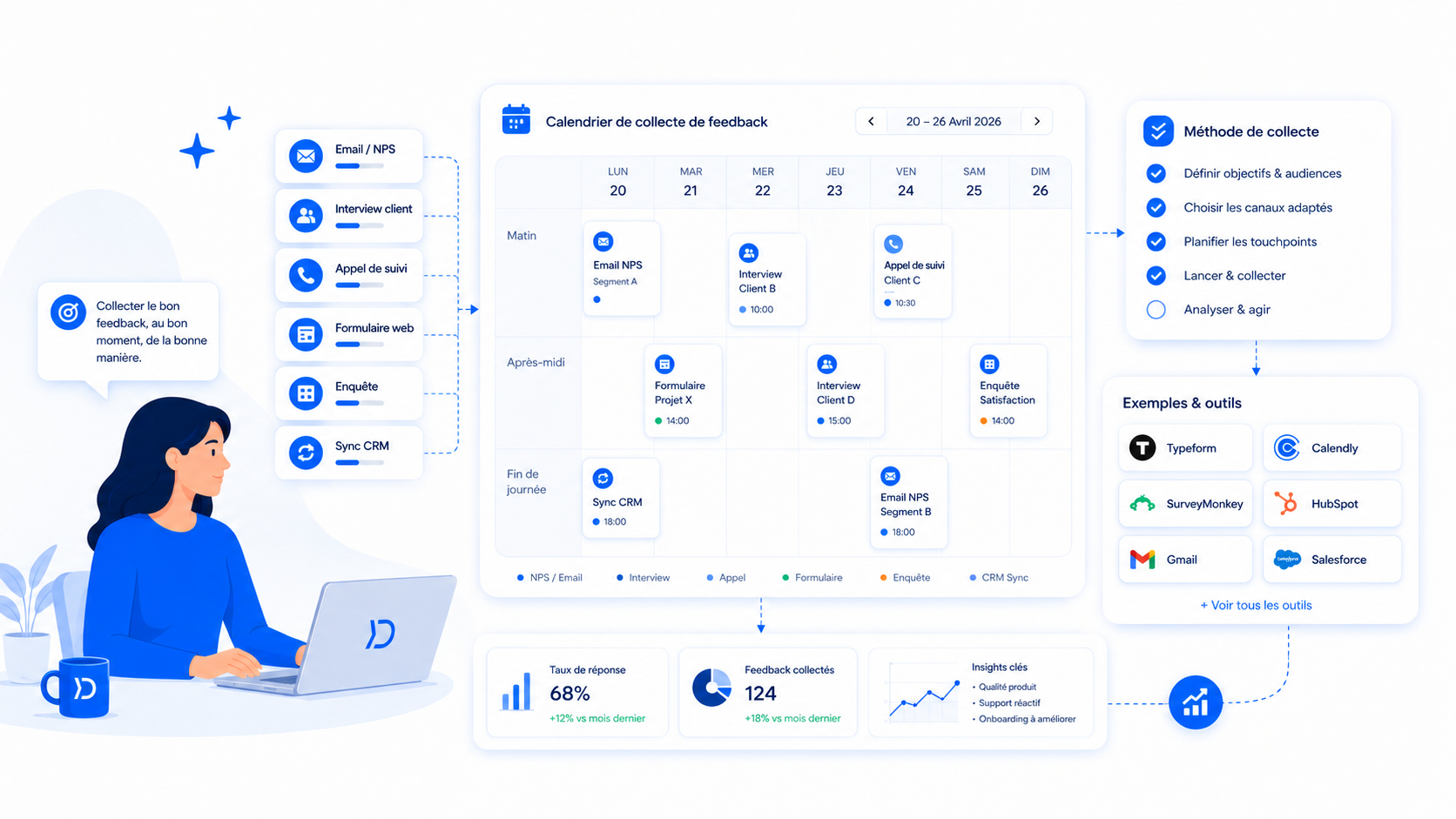
A customer feedback collection calendar is a structured plan that indicates when and how to interview buyers throughout the lifecycle. Unlike a one-off survey or a quarterly NPS, this approach positions each collection interaction at the moment when the decision is actually being made, not after the fact.
Yet most B2B companies make the same mistake: collecting feedback outside the moment when the decision was still open. The result: reassuring scores, a vague understanding of real needs, and a part of the truth, the part your prospects and customers will never tell you directly, that remains inaccessible.
According to a Forrester study (2023), 74% of B2B companies claim to collect customer feedback, but only 30% say they use it systematically to guide their decisions.
This article offers a concrete method for collecting customer feedback at the right time: new business, existing business, hybrid approach. With calendar examples, formats adapted to each configuration, and recommendations to improve the customer experience and commercial performance.
Why customer feedback collection is often poorly positioned in the customer experience cycle ?
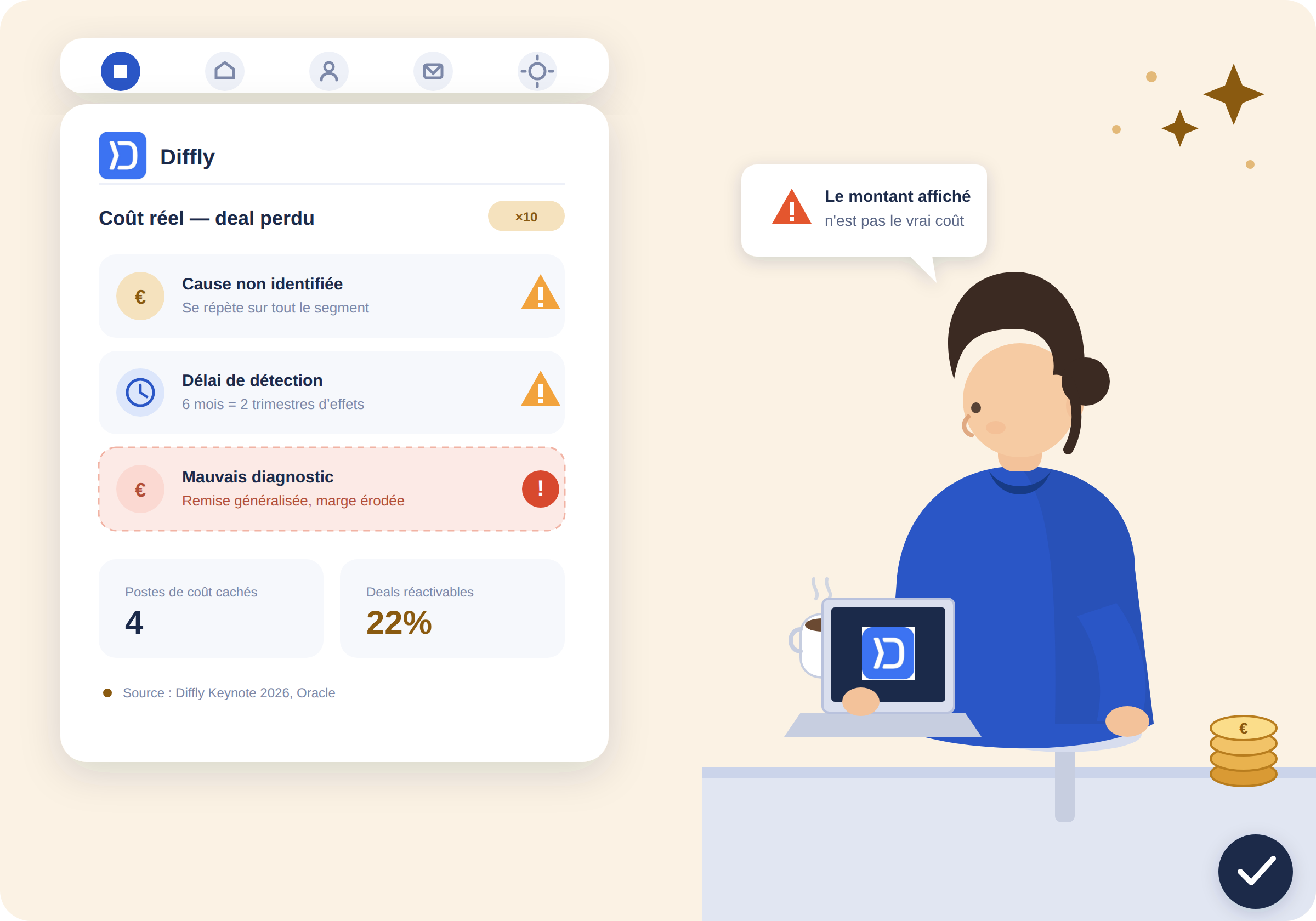
A company can display an NPS of 45 and lose 20% of its portfolio at renewal in the same year. Another may receive no negative reviews about its customer service, only to discover six months later that its customers migrated to a competitor for reasons no one had ever asked about.
The problem is not a lack of data. Companies often have plenty of information: survey results, CSAT scores, spontaneous comments, customer reviews on third-party platforms, feedback passed on by sales teams. The problem lies in how this data is collected, positioned in the cycle, and used over time.
Three structural biases explain this gap. Feedback is collected at a single point in the cycle, often post-interaction, with no connection to the customer's actual decision. Analysis is conducted in silos, without being put into perspective with commercial performance. And interpretation remains internal. Teams naturally confirm what they already think they know.
McKinsey (2022) estimates that companies that structure their feedback collection around key decision moments show a retention rate 15 to 20 points higher than those relying solely on aggregated indicators.
A good collection process is not measured by the volume of responses received. The value of a feedback calendar lies in its ability to inform commercial, product, and marketing decisions and create a real impact on performance.
Why a neutral third party collects information you cannot obtain internally ?
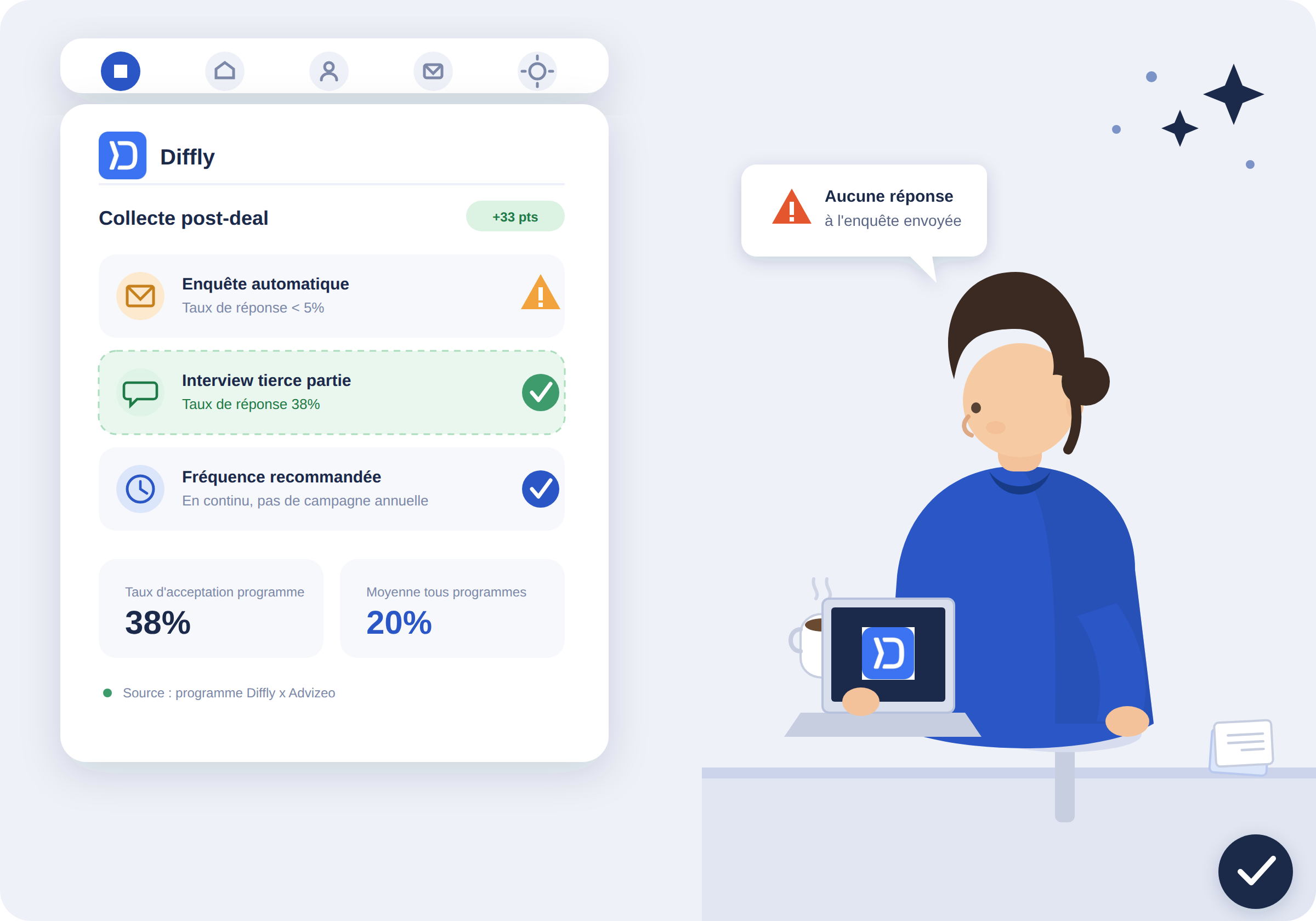
This is the limitation every team encounters, regardless of the quality of their process: when the company itself conducts the interviews, part of the truth never comes out.
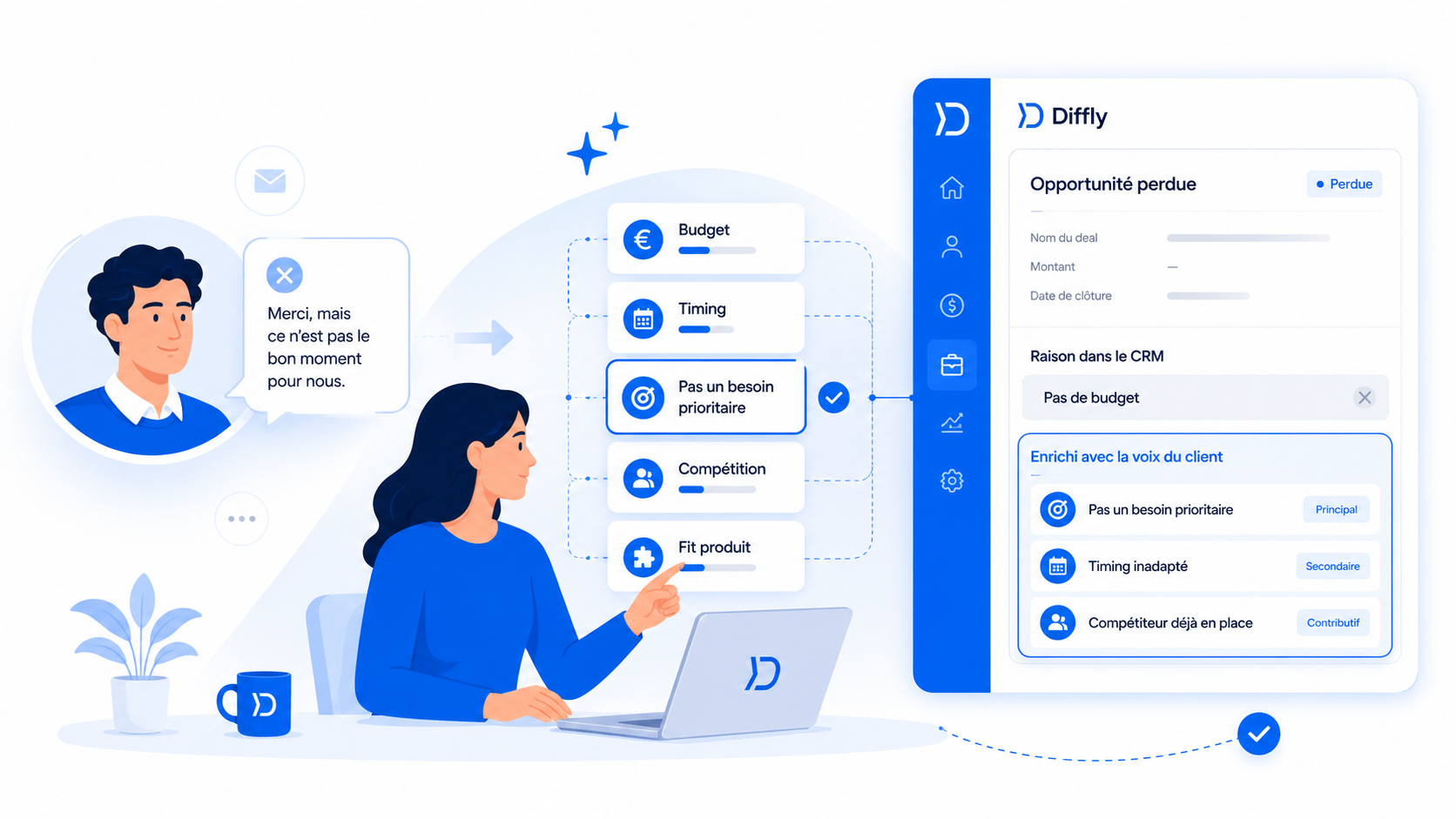
A prospect who chose a competitor will not frankly tell your salesperson that your product was perceived as too complex, that your pitch lacked credibility on a specific point, or that the real decision-maker was never convinced. They will give an acceptable answer. Price, timing, internal priorities.
A customer who churned will not explain to your Customer Success Manager that the value was never there, that onboarding was confusing, or that they started evaluating alternatives as early as the third month. Especially if they want to avoid an uncomfortable exchange or anticipate a future commercial relationship.
A neutral third party fundamentally changes the nature of the responses obtained, for three core reasons.
They have no stake in the relationship. The interlocutor knows their answers will not directly penalize anyone, create commercial tension, or be used against them in a future negotiation. This perceived neutrality frees up conversation on the most sensitive topics: the real reasons for leaving, the product's perceived weaknesses, the doubts left unexpressed during the sales cycle.
They can reach the interlocutors the company cannot contact. A prospect who said no no longer has a relationship with the sales team. A customer who churned has often cut ties. A third party can approach these profiles without it being perceived as an attempt at recovery or commercial pressure.
They structure the analysis without confirmation bias. Internally, teams interpret feedback through their own lens. A third party brings an external reading, capable of identifying what internal teams do not want, or cannot, see.
This is precisely where the value of an outsourced approach lies: not simply in the ability to conduct interviews, but in the quality and honesty of the information gathered, which would simply not be accessible otherwise.
There is no universal calendar for collecting customer feedback
Before setting up any approach, one essential question must be asked: what is the strategic point you are trying to improve?
The right calendar for collecting customer feedback depends on the weight of new business versus existing business, the level of commercial maturity, and the stakes around churn or growth. According to Gartner (2023), B2B organizations whose revenue is primarily driven by renewals should allocate at least 60% of their feedback collection effort to existing business, a ratio that the majority inverts in practice.
The goal is to capture information at the moment when the decision is actually being made. Not too early, when the need has not yet been clarified. Not too late, when the choice is already set and the room for maneuver is limited.
Three typical profiles emerge. A company in strong acquisition mode must focus its analysis on the initial purchase decision and competitive arbitration factors. Understanding why buyers choose your product over an alternative, or why they choose the status quo. A mature organization must structure follow-up over time to secure renewals and detect weak signals before they become visible. A company in repositioning mode must understand customer expectations at different points in the cycle to validate the alignment between its new message and buyer reality.
New Business Calendar: analyzing feedback to understand why deals are won and lost
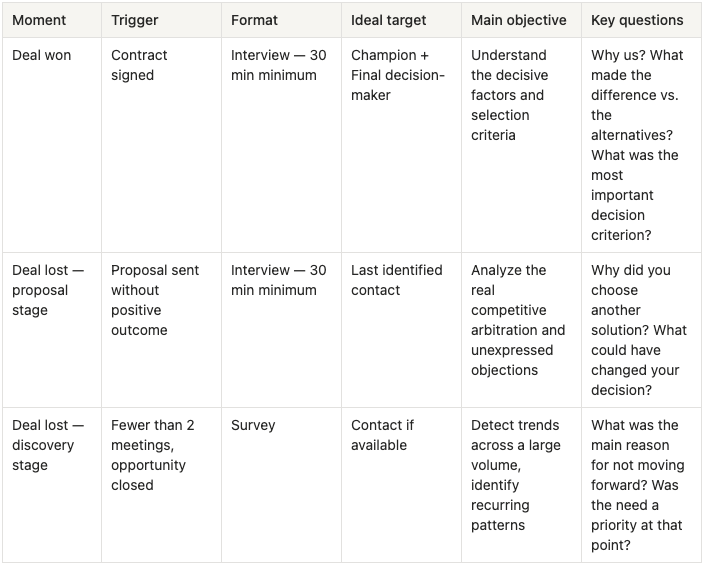
In new business, the strategic moment is the purchase decision. This is where the arbitration between your product, your competitors, and the status quo plays out. Collecting customer feedback at this precise moment yields information that neither CRM tools nor commercial activity reports can provide.
Without structured win-loss analysis, sales teams rely on their own explanations. The price was too high, the need was not a priority, the timing was wrong. These interpretations become unverified internal truths that drive poor decisions around positioning, messaging, and product development.
According to Winning by Design, B2B SaaS companies that conduct structured win-loss interviews improve their closing rate by 10 to 25% in 12 months, by adjusting their pitch based on buyers' actual decision criteria.
New Business Calendar Example
Advantages and disadvantages by format
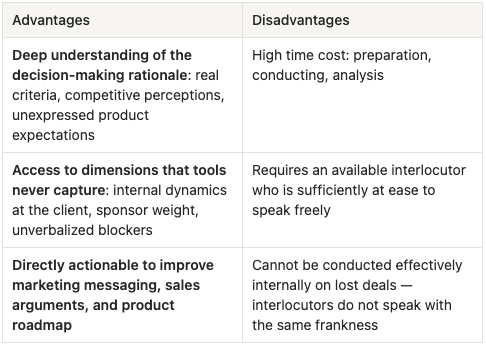
Interview — 30 min minimum (won deal or deal lost at advanced stage)
Survey (deals lost early in the funnel)
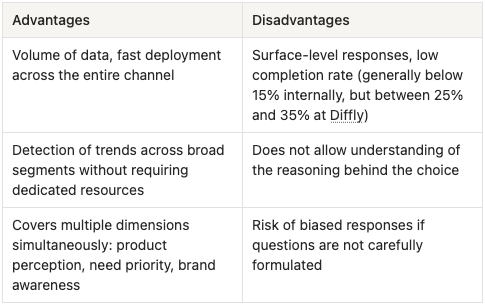
Prioritization rule: focus qualitative effort where real competitive comparison took place. A deal lost after a single discovery call warrants a survey — not a 30-minute interview. A deal lost after a demo and a commercial proposal deserves in-depth analysis: that is where the real arbitration happened, and where the most strategic information is accessible.
Existing Business Calendar: collecting feedback to anticipate churn and strengthen customer loyalty
In existing business, the challenge is no longer acquisition. It is customer loyalty and churn prevention. Collecting feedback at this stage means staying connected to the evolution of your customers' needs and their perception of value over time.
Too many companies wait for cancellation to analyze the causes. By that point, the room for maneuver is almost zero. According to Bain & Company, increasing the retention rate by 5% can increase the profitability of a B2B company by 25 to 95%. The window for action sits well before the cancellation decision — and a structured calendar makes it possible to identify it.
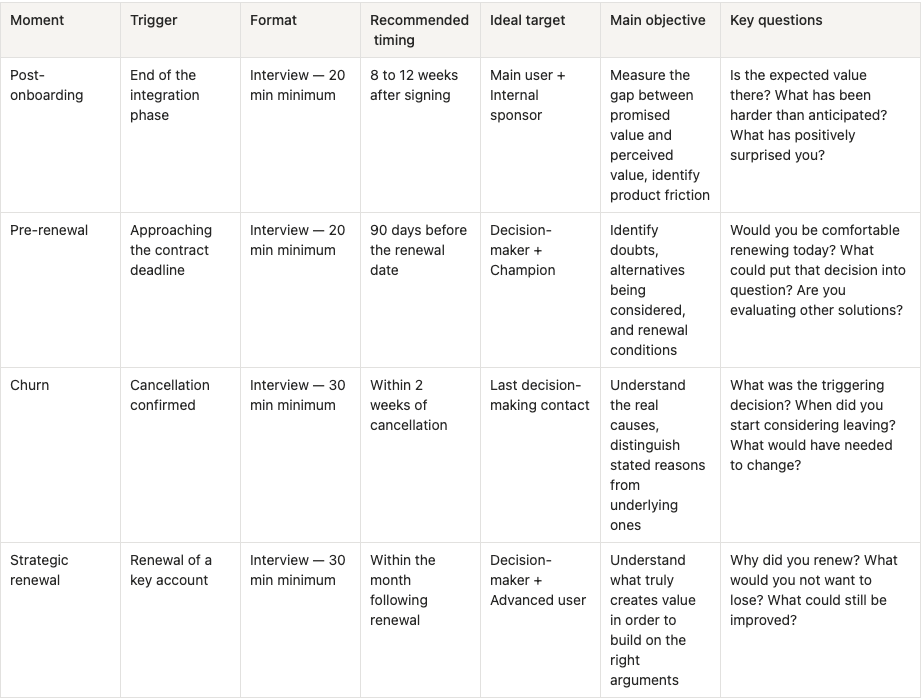
Existing Business Calendar Example
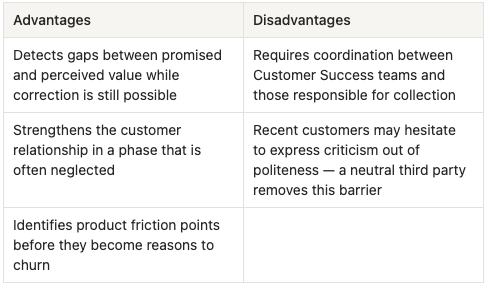
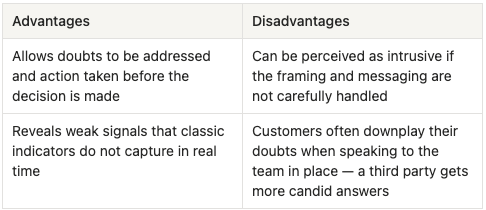
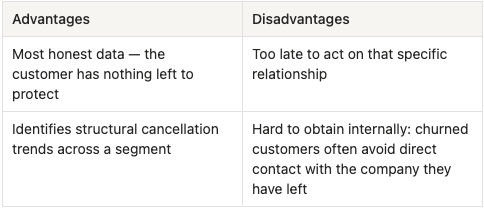
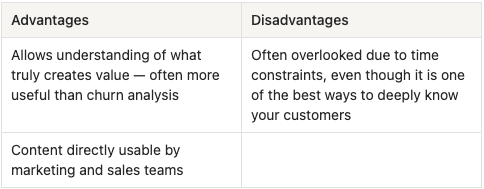
Advantages and disadvantages by moment
Post-onboarding interview
Pre-renewal interview
Post-churn interview
Strategic renewal interview
Key warning signal: if the post-onboarding interview reveals that the promised value has not yet been perceived at three months, there is still a window to act. Waiting for renewal is often too late.
Hybrid approach: covering the entire customer lifecycle with a continuous feedback strategy
The hybrid approach is recommended for organizations that need a transversal and continuous reading of buyer decisions, regardless of the stage in the cycle. It combines three complementary levels.
Targeted win-loss interviews focus on the most strategic deals, those where real competitive arbitration took place, where the financial or symbolic stakes were significant. These interviews provide deep qualitative understanding impossible to achieve through a survey or an indicator.
Regular surveys allow trends to be measured at scale while covering multiple dimensions simultaneously: product perception, competitive positioning, satisfaction, future intentions. They do not replace qualitative work. They serve to detect weak signals and prioritize topics to explore further in interviews.
Interviews on critical moments, onboarding, new feature launch, approaching renewal, maintain a continuous connection with the evolution of customer expectations and product perception over time.
Measuring customer satisfaction is not enough: using customer feedback to improve the experience and take action
The most common trap: teams collect, produce reports, present scores in management committees and improve nothing. According to a Qualtrics XM Institute study (2023), 63% of CX professionals say their organization collects more feedback than it can effectively process.
A good feedback calendar must integrate a clear action mechanism, with an identified internal owner for each type of insight.
Marketing uses insights to refine positioning, adapt messaging, and align communication with the real expectations of buyers. Win-loss interview verbatims are a direct source of authentic content.
The product team analyzes feedback to identify friction points, prioritize development, and improve the product based on real needs — not internal assumptions.
Sales teams use the learnings from win-loss interviews to sharpen their arguments, better handle competitive objections, and adapt their pitch to buyers' actual decision criteria.
Customer service identifies recurring friction-generating interactions to address causes upstream rather than responding to symptoms.
Feedback only has strategic value when it is shared internally, contextualized against the company's objectives, and translated into measurable improvements over time.
Conclusion: stop telling yourself stories
Without a structured calendar, a company can collect a great deal of information and still poorly understand its buyers. Data accumulates. Scores are presented. And decisions continue to be made on the basis of unverified internal interpretations.
Staying close to your buyers also means accepting that some truths do not naturally surface internally. The prospects who said no, the customers who left, the decisions made without ever telling you frankly: this information exists, it is accessible. But it requires a framework of trust and a neutrality that only a third party can provide.
This is exactly what Diffly does. If you want to structure your feedback approach or understand what your buyers are not yet telling you, you can book a time here.
Customer satisfaction is not just measured. It is built over time, step by step, by collecting feedback at the right moment, analyzing with method, sharing insights with the right teams, and acting quickly on what can be improved.

Richtext Templates

"Lorem ipsum dolor sit amet, consectetur adipiscing elit. Suspendisse varius enim in eros elementum tristique."
John Doe
Name, Role @Google

Analysing CRM data is a good 1st step but I know I only get 20% of the real story

Constance Morales
Constance Morales, Product Marketing Manager @ Scaleway