Summarize this article with:
In B2B, the race for visibility into sales conversations has intensified. Call recording applications and specialized software have become standard tools within sales teams, promising to capture every word, every objection, every key moment in a phone conversation with a prospect or client. But this promise of total transparency hides a major blind spot: recording phone calls does not explain customer buying decisions.
Automatic call recording solutions capture what is said during the 17% of the time your sales teams are in direct contact with the prospect or client. The Win/Loss approach offered by Diffly, on the other hand, reveals what happens during the remaining 83%, where real trade-offs, internal blockers, and the true reasons why a deal is won or lost inside the client organization actually take place.
This article does not aim to discredit call recording tools. They offer useful features, sometimes even essential for sales teams. But it is time to clarify what they truly capture, what they systematically miss, and why a high-performing company cannot rely solely on recording calls to understand its customers.
Why call recording applications became standard in companies ?
Automatic call recording platforms have transformed sales teams. These software solutions offer unlimited call recording features, real-time call transcription, call summaries, and integrate with CRMs (Salesforce, HubSpot, Pipedrive). Their easy-to-use interface allows users to access recordings from a mobile application.
These platforms are excellent for sales coaching and managing the quality of inbound and outbound calls. Your call data is available in real time within the CRM. These tools are operational execution solutions not strategic intelligence tools about customer expectations.
These solutions make it simple to store conversation recordings, share best practices among users, and activate customization options based on each team’s needs.
What call recording tools do very well for sales teams ?
The best call recording applications capture what is said, by whom, and at what moment. They allow teams to refine their pitch, personalize their messaging, train their teams, and detect linguistic patterns. Automatic recording simplifies users’ daily work and improves the customer experience. Users can receive automatic notes during each conversation, access information through an intuitive interface, and easily manage the phone numbers of their professional contacts.
But their scope ends where the conversation ends.
What call recording systems cannot capture on the customer side ?
Call recording applications have a structural limitation: they only capture direct phone interactions. Yet in B2B, most decisions are made after phone calls.
Once the call ends, the prospect or client returns to their company. That is where everything happens:
- Internal discussions between decision-makers, end users, finance, IT, legal. Budget trade-offs without you present. The absence of a key decision-maker in the client organization whose phone number you never obtained. The weight of the status quo that kills hundreds of deals.
Your main contact may be convinced, ready to sign. But if the company’s CFO has other priorities, if the sponsor lacks political influence, the deal will not happen. None of this appears in your call recordings.
What the customer says during a phone call is not always what truly matters. Internally within their organization, pricing, CRM integration, or compatibility may determine the final decision. Recording applications capture the speech, not the real expectations, which only become visible through post-decision research. Even the best platforms with advanced features cannot provide these insights because they only capture part of the decision-making process.
Most lost opportunities simply evaporate. The prospect stops replying to emails and postpones meetings. Recording systems show the last exchanges but never explain why the deal died. This is where qualitative research becomes essential.
.png)
Call recording tools are a good starting point, but they cannot be sufficient on their own if you truly want to understand what makes you win or lose deals.
Where Win/Loss Analysis changes the perspective for your company ?
The Win/Loss approach offered by Diffly is based on a radically different principle: it does not start from the recorded conversation, but from the customer’s final decision.
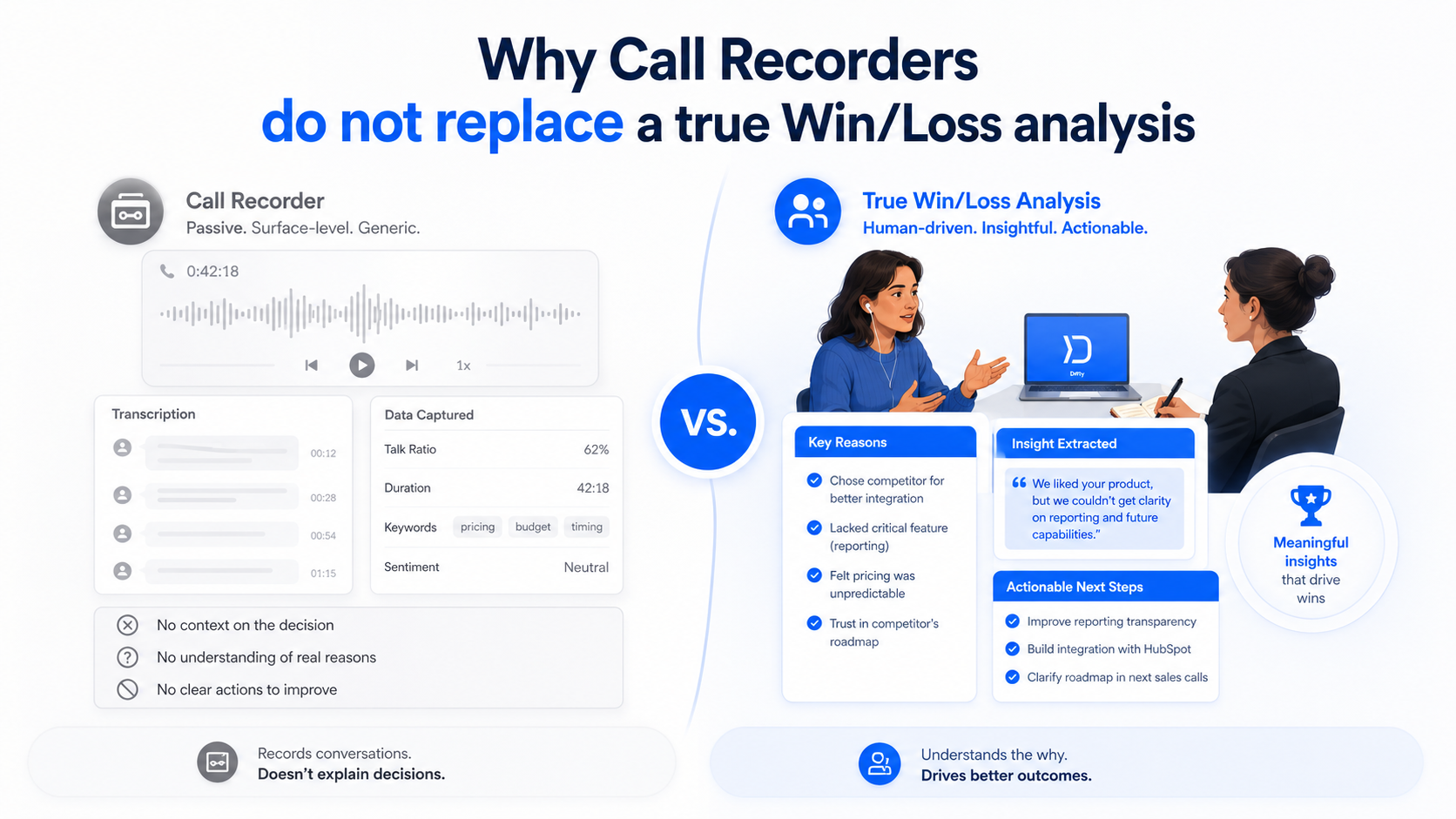
Call recorders provide data about how the conversation unfolded. Win/Loss explains why the customer made their decision. A deal can be lost despite flawless phone calls and impeccable service quality. What matters is alignment with the client’s internal priorities, the influence of the sponsor, and budget timing.
To illustrate: Diffly’s Win/Loss approach relies on structured interviews conducted after the decision with decision-makers on the client side. This qualitative research reveals what truly mattered, what blocked internally, and what was ignored during the sales cycle. This approach helps companies start from real customer needs to improve their service and value proposition in a targeted way.
Win/Loss answers the question: “What actually tipped the decision?”
This question cannot be answered by listening to call recordings, no matter how easy your platform is to use. It requires a direct conversation with decision-makers. It is qualitative research that goes beyond what an application can offer.
Where recording platforms improve sales execution, the Win/Loss approach improves strategy: accessible segments, effective messaging, purchasing obstacles, competitive blind spots, unspoken expectations.
Call recording solutions and Win/Loss: two complementary tools
Call recording solutions and the Win/Loss approach do not answer the same questions or serve the same objectives. Each tool has its role:
- Call recorder: improves sales execution and performance. Focuses on how you speak, and the quality of interaction with customer service. Target users: sales managers, sales reps, enablement teams, agents. Short-term horizon for coaching, training, and quality management.
- Win/Loss: explains customer buying decisions. Focuses on why a decision was made, and what truly mattered. Target users: sales leadership, marketing, product, C-level executives. Medium- to long-term horizon for strategy, positioning, and go-to-market optimization.
Teams can use both types of solutions in a complementary way: one to manage daily performance and agent training, the other to gain strategic understanding of customer choices.
Winning companies invest in both tools. They use call recording applications to professionalize their teams and facilitate training. They use Win/Loss to decode their market, adjust their positioning, and make decisions based on qualitative customer data.
A call recording application will never replace a Win/Loss approach, and vice versa. They are two layers of intelligence that reinforce each other to provide a complete view. The decision to invest in these tools must be based on your company’s objectives: improve operational execution or understand the decision dynamics that impact your revenue.
If you are a C-level executive, you cannot afford to rely solely on a call recording system. It will not answer the important questions: why your win rate is stagnating, why your deals are being lost, or why your forecasts are overly optimistic.
Conclusion: operational visibility vs. strategic understanding of customers
To summarize, call recording applications are tools for operational visibility. They show phone conversations with your clients and prospects, help train your sales teams, and manage customer service quality. These platforms offer performance tracking features. These systems allow teams to manage interaction quality, facilitate daily work, and provide customization options for each user.
The Win/Loss approach is a tool for strategic understanding. It explains why decisions are made, helps adjust your strategy, identify blind spots, and make informed go-to-market decisions based on real customer expectations. It is a professional service that retrieves information where no application can access it. It provides access to strategic insights that recording tools cannot deliver, based on direct interviews with decision-makers.
When it comes to revenue, understanding is worth more than recording. You can have the best calls, a high-performing platform, and still lose deals. The problem is not execution, but positioning, timing, and understanding your client’s internal dynamics.
Call recording solutions tell you whether you played well. Diffly’s Win/Loss approach tells you whether you are playing the right game.
Recording phone conversations helps you sell better. Explaining decisions through the Win/Loss approach helps you sell more often.
Frequently asked questions about call recording tools and Win/Loss Analysis
What is the difference between a call recording application and Win/Loss analysis for sales teams?
An automatic call recording platform captures what is said during phone conversations between your sales teams and prospects — 17% of the sales cycle. These solutions offer features to improve execution: pitch quality, objection handling, agent performance. The easy-to-use interface allows access to your call data in real time, note creation, and sharing recordings with your team. Diffly’s Win/Loss approach is qualitative research based on structured interviews conducted after the decision. It reveals the 83% when you are not in contact with the client: internal discussions, budget trade-offs, real decision criteria within the organization. The two tools are complementary.
Why is Win/Loss analysis important even if I use call recording software?
Call recording software provides visibility into interactions, but not into the full decision-making process. Even with advanced features (call transcription, summaries, CRM storage), these systems do not capture what happens within the client’s organization: internal meetings, budget trade-offs, email exchanges, discussions between decision-makers. Diffly’s Win/Loss approach gathers this information by interviewing contacts and decision-makers directly. This professional service helps identify why you lose to certain competitors, which needs you fail to address, and what truly matters to clients within their company.
How should I choose between investing in a call recording platform or Win/Loss analysis?
If your sales teams lack consistency or require structured training, call recording software is an excellent starting point. If your win rate is stagnating, if you consistently lose to the same competitors, or if your forecasts lack accuracy, Win/Loss analysis becomes essential. For C-level executives, Win/Loss provides strategic insights needed to make informed positioning and go-to-market decisions.
What features do the best call recording applications offer?
The best platforms provide essential features: automatic recording enabled by default, real-time call transcription, automatically generated summaries, and note-taking during conversations. The easy-to-use interface allows access to recordings via a mobile application across devices. Users can store data in the CRM, share recordings with their team, create contact lists, and manage phone numbers. These solutions also offer customization options, inbound and outbound call management, and performance statistics. Some platforms even offer unlimited calls and free versions for smaller teams.
How do recording data help train agents?
Call recording systems facilitate training by allowing managers to use real recordings as case studies, share best practices between agents, and provide personalized coaching sessions. Transcription features allow quick search for specific moments within calls to illustrate important points. Teams can build categorized recording libraries based on situations. This data-driven approach improves service quality and commercial performance. New users can access these resources through the mobile application and learn at their own pace.

Richtext Templates

"Lorem ipsum dolor sit amet, consectetur adipiscing elit. Suspendisse varius enim in eros elementum tristique."
John Doe
Name, Role @Google

Analysing CRM data is a good 1st step but I know I only get 20% of the real story

Constance Morales
Constance Morales, Product Marketing Manager @ Scaleway