Summarize this article with:
In the B2B world, Win Rate has become an almost universal benchmark. It is viewed like a score. It is analyzed like a performance metric. It is tracked the way you would track the number of wins a team gets over a season.
Today, this win rate is the main KPI used by many sales leaders. It shows a percentage of wins, a win/loss ratio, a single summary number that is supposed to reflect overall momentum.
But a rate does not tell the whole story.
Win Rate shows how many deals are won out of a total number of opportunities. On its own, it does not make it possible to assess the quality of a strategy or the reasons behind a loss.
That is where the confusion begins.
How to calculate your win rate and win ratio ?
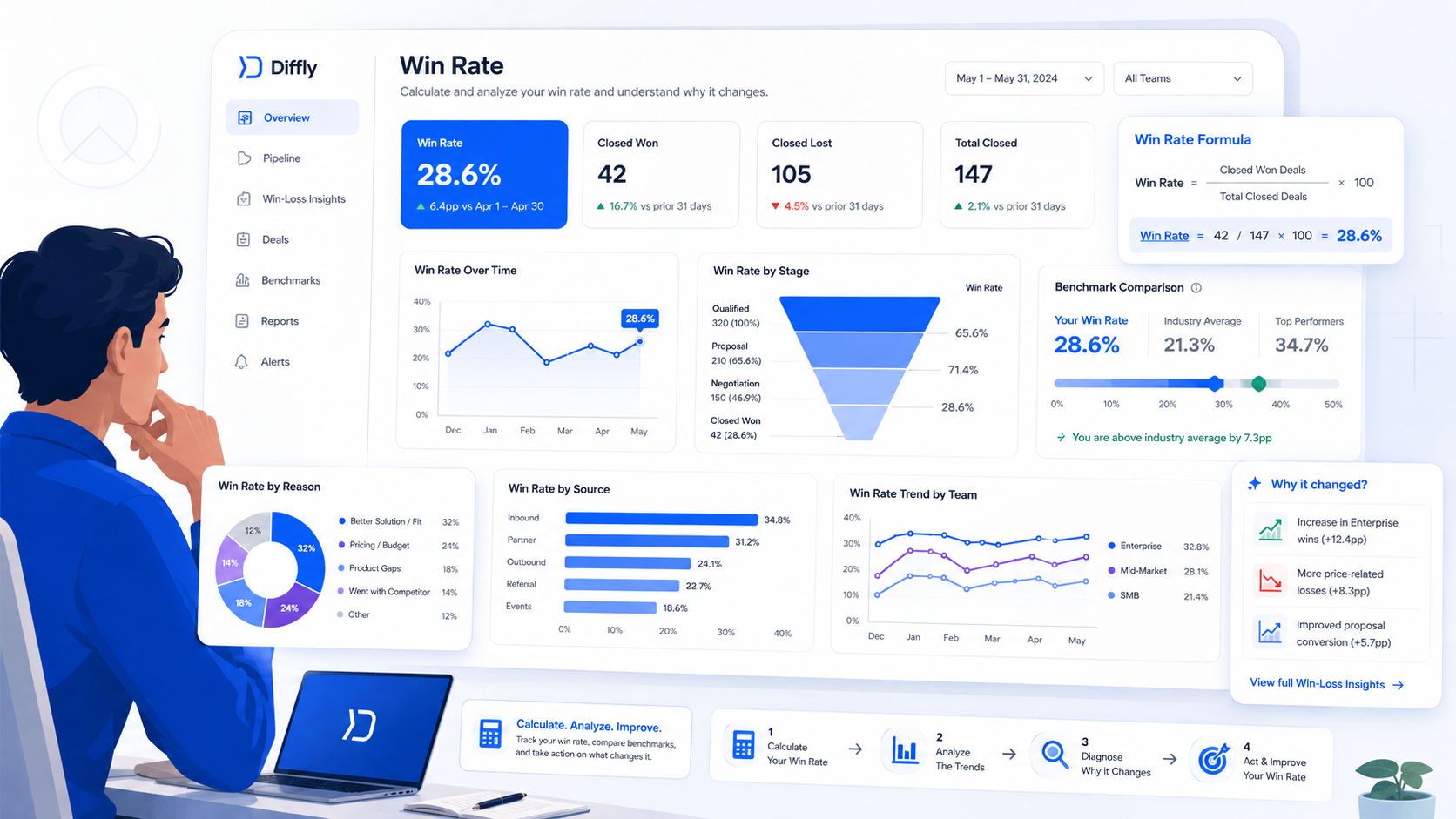
Calculating win rate is simple: divide the number of wins by the total number of opportunities, then multiply by 100 to get a percentage.
For example, if a sales team has 50 opportunities and wins 15 deals, the win ratio is 30%.
This calculation provides a clear measurement. It makes it possible to evaluate a sales period, compare one quarter to the previous one, and observe a trend.
In a complex environment, having a rate like this helps teams manage growth. It provides a performance benchmark and serves as an internal reference point.
But this calculation remains limited.
It shows a macro result. It does not explain the micro cause.
Why the percentage of wins can be misleading ?
When the percentage of wins declines, the reaction is immediate. People assume there is an execution problem. Training is reinforced. Efforts are made to improve individual skills.
But a lower ratio does not necessarily mean a lower level of performance.
A lower rate can mean:
- a market shift
- increased competitive pressure
- a change in segment
- a poorly aligned strategy
The percentage does not distinguish between these factors.
In sports, a team can lose several close matches during a tournament while still performing at a high level. Conversely, a team can post a high number of wins against weaker opponents.
The number alone is not enough to assess real performance.
What Win Rate does not show in the sales game ?
Win Rate aggregates all deals into one overall ratio.
It does not distinguish between:
- a loss caused by budget trade-offs
- a deal lost to the status quo
- a contract lost to a better-positioned competitor
- poor timing
It adds up the outcomes without differentiating the causes.
A high rate does not guarantee a strong strategy. A lower rate does not necessarily mean poor sales skills.
Optimize the rate or rethink the strategy?
When win rate drops, companies immediately try to optimize sales execution: scripts, pitch, coaching.
But improving execution is not always enough.
Maybe your offer is no longer the right fit. Maybe the budget cycle has changed. Maybe decision criteria have evolved.
The problem is not always in the way the match is played, but in the strategy itself.
This is where Win/Loss analysis becomes critical.
Win/Loss: moving from a global ratio to deal-by-deal analysis
Win Rate gives you an overall view. Win/Loss looks at each deal individually.
It examines every win and every loss to determine:
- why the deal was won
- why it was lost
- why no decision was made
Where win rate shows an overall result, Win/Loss provides strategic understanding.
It is a qualitative analysis that complements quantitative measurement.
Win Rate vs. Win/Loss: two levels of analysis
Win Rate is a high-level metric. Win/Loss is a detailed analysis.
The first helps track a trend. The second helps identify the levers for improvement.
In today’s competitive environment, relying only on the overall ratio is like looking only at the scoreboard without analyzing the game itself.
High-performing companies use both:
- win rate to steer performance
- Win/Loss to adjust strategy
From averages to sustainable growth
A high rate can hide a fragile average. A company may win most of its deals in one specific segment while consistently losing elsewhere.
Dividing the number of wins by the total number of opportunities gives you an overall ratio. But to improve growth sustainably, you need to analyze each deal individually.
Growth does not come from calculation alone. It comes from the ability to understand why certain opportunities are lost.
Conclusion
Win Rate is a performance indicator. Win/Loss is a strategic lever.
A ratio does not protect your revenue. A deeper analysis does.
Win Rate tells you how much you win. Win/Loss tells you why.
And in a race for growth where every deal counts, understanding will always matter more than counting.
FAQ – Win rate and Win/Loss analysis
How do you calculate your win rate accurately?
Win rate is calculated by dividing the number of wins by the total number of opportunities, then multiplying by 100 to get a percentage.
Does a high win rate always mean the team is performing well?
No. It is important to note that a high ratio can hide structural weaknesses or an overreliance on a specific segment.
Why is analyzing losses so important?
Because every loss contains strategic information that can help improve overall performance.
What is the main difference between Win Rate and Win/Loss?
Win Rate shows an overall result. Win/Loss helps identify the individual causes behind each won or lost deal.
Should win rate be used as the only benchmark?
No. Win rate is a useful indicator, but it should be complemented by qualitative analysis.

Richtext Templates

"Lorem ipsum dolor sit amet, consectetur adipiscing elit. Suspendisse varius enim in eros elementum tristique."
John Doe
Name, Role @Google

Analysing CRM data is a good 1st step but I know I only get 20% of the real story

Constance Morales
Constance Morales, Product Marketing Manager @ Scaleway