Summarize this article with:
Win-Loss Analysis (or analysis of wins and losses) is a method that consists of interviewing prospects or customers after a purchasing decision to understand why a company won or lost a deal.
“We’ll do it ourselves.”
This reflex is common when a B2B company decides to launch a Win-Loss Analysis program. You already have a CRM, a competent team around the table, customers you can contact — so why involve a neutral third party?
The problem is that this approach looks simple on paper. In theory, it’s about understanding why you win or lose contracts. In practice, the way you collect, interpret, and share this feedback will determine whether you turn it into a real go-to-market advantage — or a set of anecdotes that send you in the wrong direction.
According to Forrester (2023), 65% of internally launched Win-Loss Analysis programs are abandoned within the first six months due to lack of resources, structured processes, or sufficient volume. Here are the 5 key reasons not to internalize everything — and how to involve your Sales, Marketing, and Product teams without doing everything yourselves.
Why internalizing seems like a good idea ?
Before addressing the risks, let’s acknowledge why the idea is appealing. You think you’ll reduce costs by avoiding an external provider. You feel like you already understand your market. You already have internal rituals: Post-Mortems, pipeline reviews, Sales debrief sessions.
The intention is good. But the execution is where the problem lies.
In reality, most internal B2B programs end up being occasional rather than continuous, guided by opinion rather than data, and poorly structured due to lack of time and methodology.
1. An internalized program is biased by nature
First key point: you are asking the players to referee the match they just played.
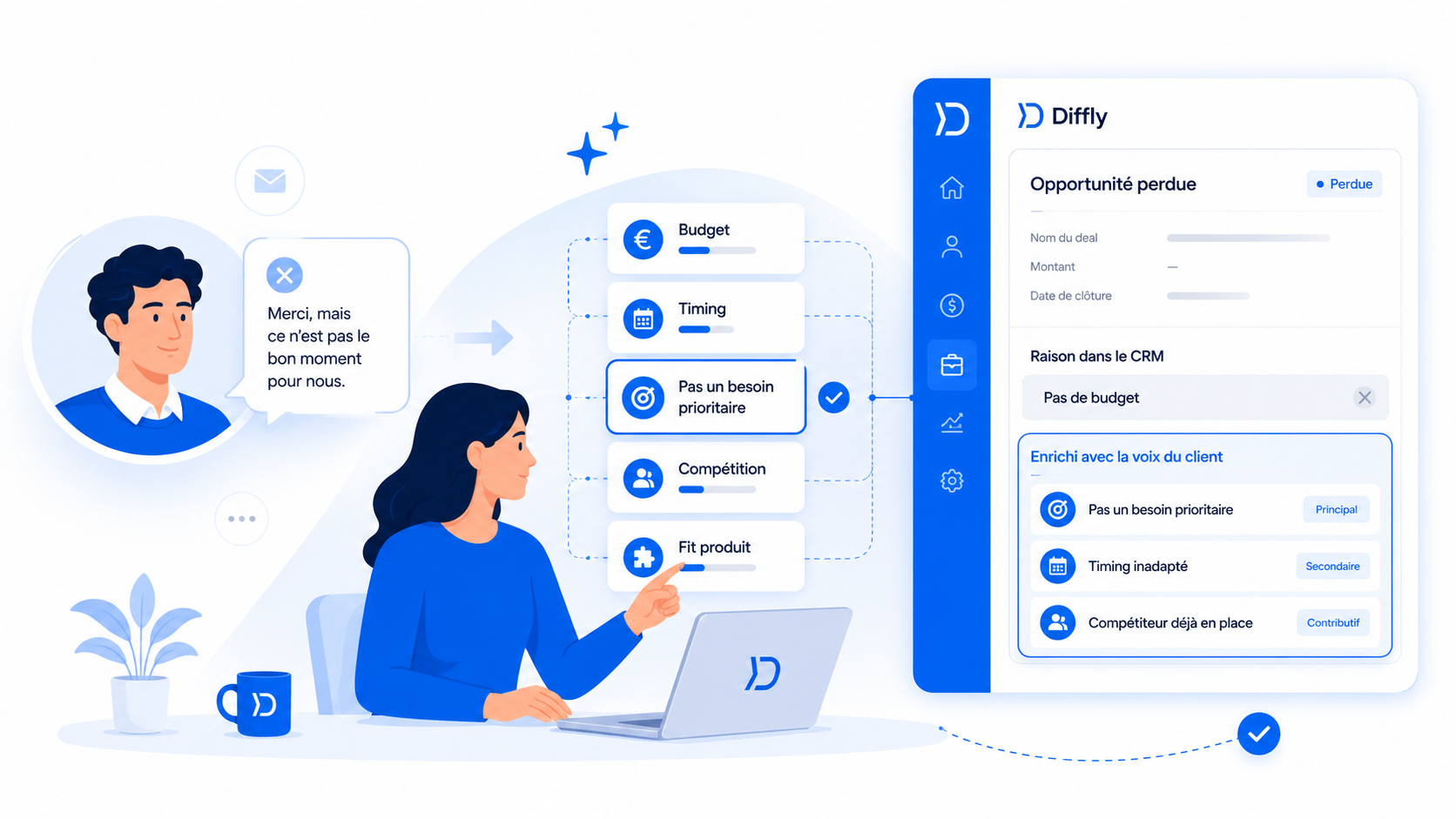
When this program is managed internally, feedback collection usually starts in one of these three places: the “reason closed-lost” field in the CRM, an internal Post-Mortem with Sales and Product, or a manager directly asking the prospect the question. All three approaches have value, but none are truly neutral.
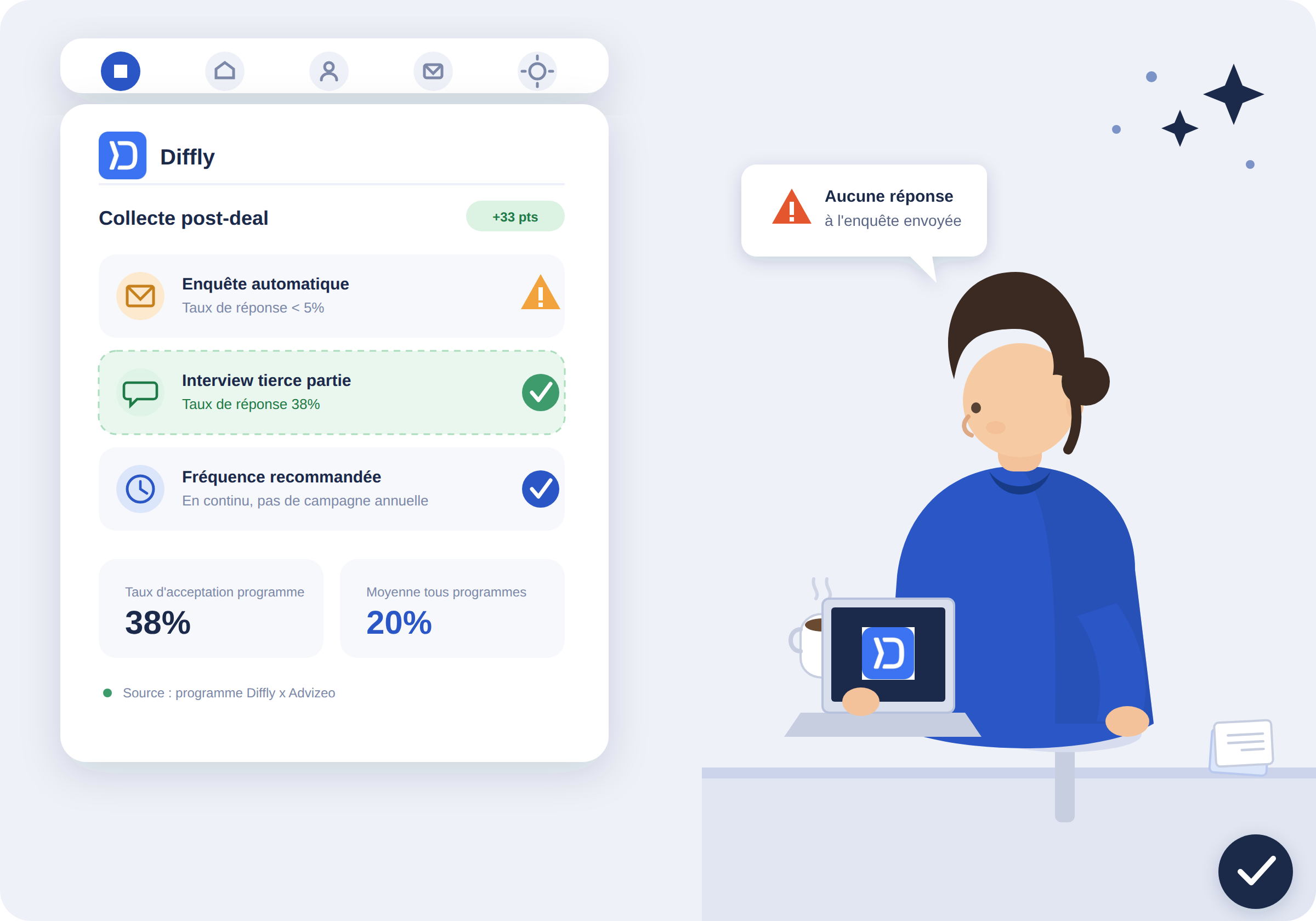
Sales teams are emotionally involved in the sales cycle, they tell the story through their own lens, under forecast pressure. Internal Post-Mortems quickly turn into blame games. And when you conduct the interview yourself, the customer will soften their message to avoid conflict and avoid reopening the negotiation.
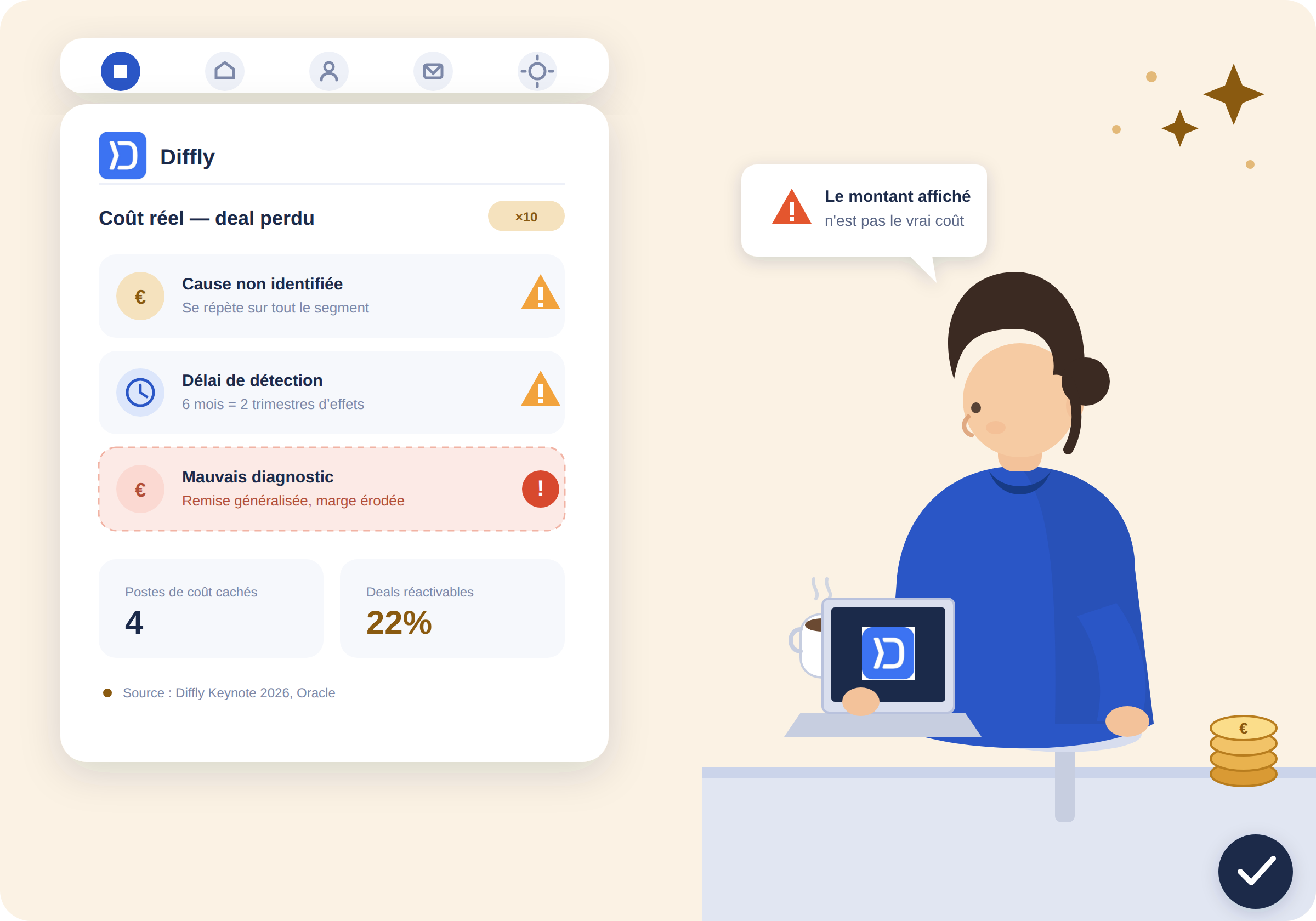
The result: very polite feedback around budget or timing, CRM data that reinforces your existing beliefs, and very little real information about the decision criteria behind the scenes.
According to Corporate Executive Board, B2B buyers withhold on average 40% of negative information when responding directly to the seller. This number drops below 10% with a neutral third party whose sole objective is to listen, not to sell.
2. You will not speak to enough customers to obtain reliable results
Second point: the lack of volume and consistency in data collection is structural.
Internal programs usually start when something hurts: a major customer churn, a strategic contract lost to a key market player, or a board challenging the quarter’s results. These cases matter, but they are not representative of your entire activity.
You miss the small won or lost deals that nevertheless tell an essential story: pricing thresholds, the rise of a competitor, messaging that does not influence buyers, recurring product gaps in the roadmap. According to Gartner (2024), you need to analyze a minimum of 15 to 20 contracts per quarter to identify reliable patterns. Most internal teams do not reach this threshold because they lack processes to systematically trigger interviews.
Without a continuous program, you never see the curve, only isolated points. And you make long-term decisions based on a very partial view of the market.
3. This approach requires expertise your employees may not necessarily have
Conducting real Win-Loss Analysis sessions is a profession in itself, not just a question to ask at the end of a meeting.
A good interviewer must know how to structure a guide aligned with your challenges (positioning, product, pricing, Sales process, competitive intelligence), identify when to let silence do the work, when to dig deeper into a reason mentioned, when to gently challenge the first answer to obtain the real buyer-side information.
Professionals trained in this approach, such as those at Primary Intelligence, Clozd, or Diffly, have conducted hundreds of qualitative and quantitative interviews. They master active listening, open-ended questioning techniques, and the reduction of cognitive biases in data collection.
When you internalize, you assign this mission to someone whose role is already a full-time job : PMM, RevOps, Sales Ops. Interviews are added on top of the current role, without dedicated training. The questions change from one contract to another, making comparison and aggregation of the data very difficult. And the study becomes subjective, difficult to defend internally, and difficult to integrate into a go-to-market action plan.
According to SiriusDecisions (Forrester), companies that outsource the synthesis of their program obtain actionable insights 3 times faster than those that internalize the entire process.
4. The operational workload ends up killing the momentum
This program is not just about asking a question. Running it seriously implies defining the scope on the B2B market (which segments, which competitors, which stages of the sales cycle), activating automatic triggers in the CRM for every won or lost contract, managing outreach and follow-ups, conducting interviews and surveys, analyzing and tagging feedback to identify patterns, and sharing structured reporting with Sales, Marketing, and Product.
Taken seriously, this is real program management. It is not a side project.
What we observe in most companies: months 1 to 2, strong motivation and a summary deck for leadership. Month 3 and beyond, priorities change, interview volume decreases, and six months later the program is sleeping in a folder. Meanwhile, your competitors who outsourced are building a continuous feedback loop and adapting their product roadmap and messaging accordingly.
5. Internal programs struggle to create a shared source of truth
Even when data exists internally, it is scattered. Sales has its vision through the CRM. Product has its own through customer requests and roadmap inputs. Marketing conducts its own market studies. Customer Success collects feedback on customer satisfaction and churn.
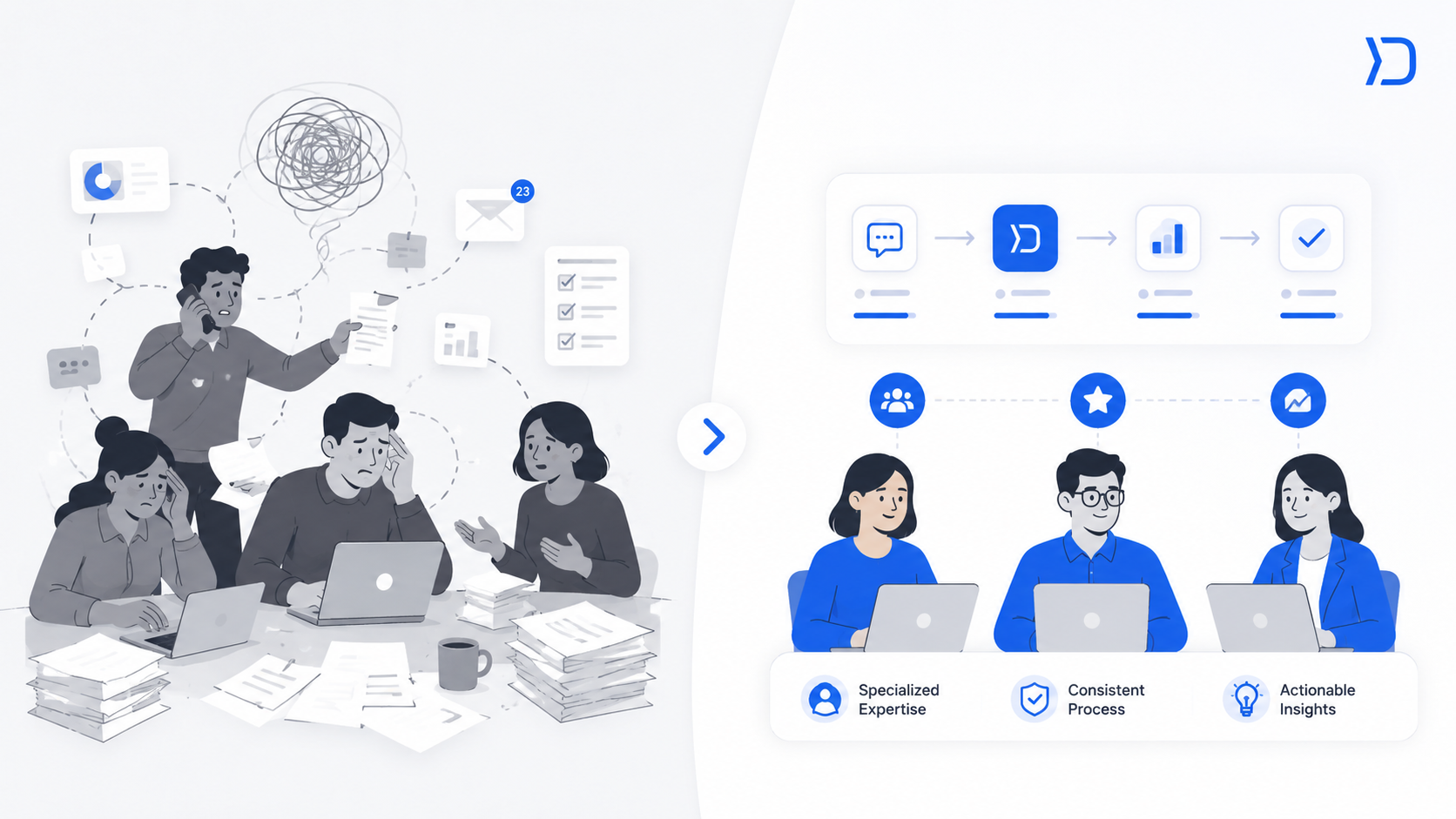
The result: versions multiply, nobody knows which document is up to date anymore, and Sales, Product, and Marketing teams tell different stories about why you win or lose contracts. Strategic decisions fall back to gut feeling because the data is not perceived as reliable enough to arbitrate a positioning, pricing, or roadmap issue.
A specialized external platform makes it possible to centralize all buyer feedback from interviews and surveys, standardize decision criteria on a common reference, and provide a shared dashboard for Revenue, Product, and Marketing teams. This is how this approach becomes real cross-functional market intelligence and not just another report in your folders.
Internal vs outsourced program: comparison table
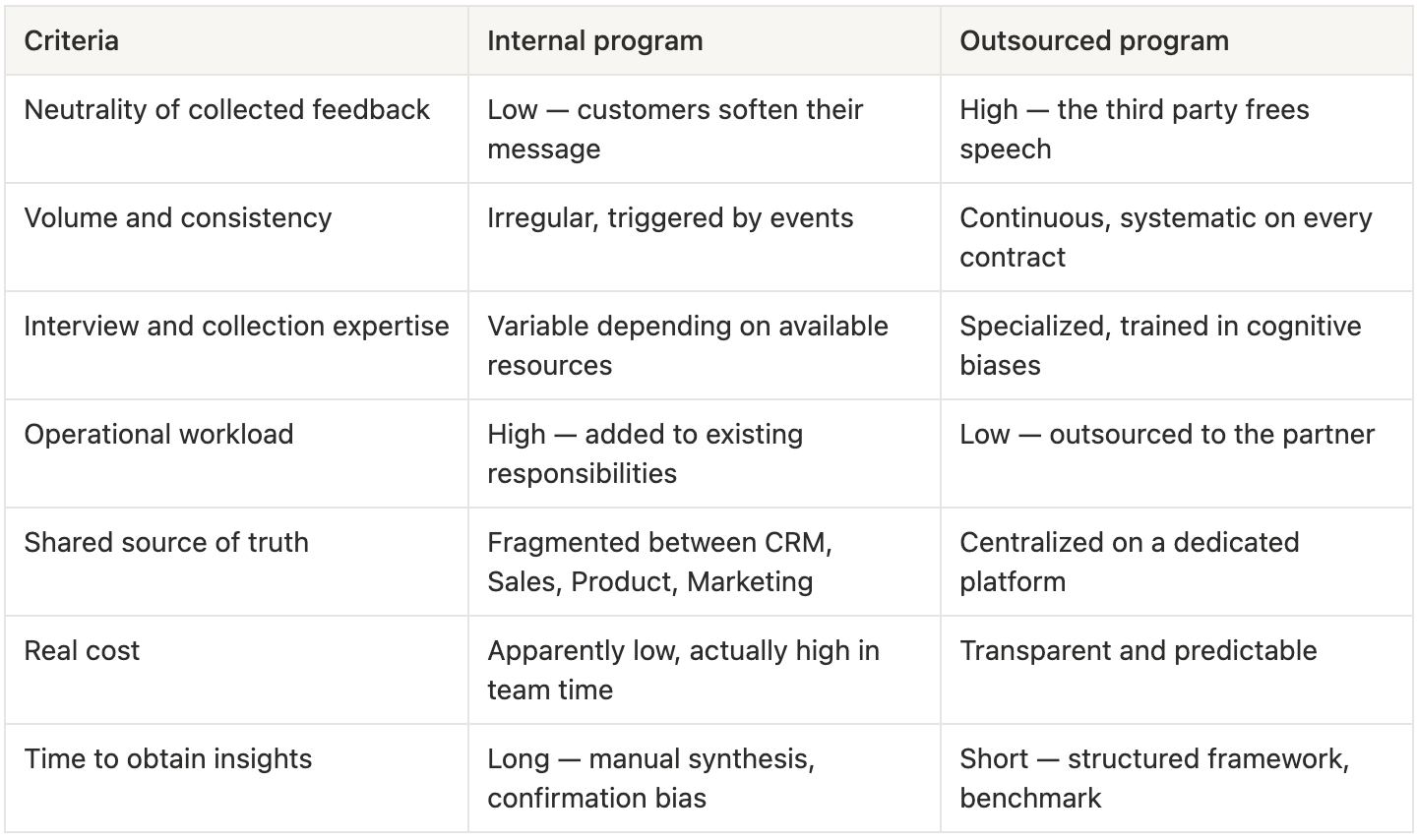
Should everything be outsourced then?
Not necessarily. Internal work remains a key foundation, but it should not be your only engine for understanding your buyers.
A realistic model combines neutral external interviews and qualitative and quantitative surveys to obtain robust feedback at scale, internal reference data from the CRM and call recordings, and a specialized partner like Diffly to structure the program, analyze the data, and surface patterns while your employees focus on action.
You keep ownership of strategic decisions. You do not add the role of researcher, interviewer, and analyst to your Sales and Marketing teams on top of their current mission.
Conclusion
Internalizing this program seems intuitive. But for most B2B companies, this approach leads to biased feedback, insufficient data volume to make confident strategic decisions, lack of expertise in interviews and collection, operational workload that exhausts teams, and fragmented insights without a shared source of truth.
Win-Loss Analysis reveals its full ROI when the program is neutral and credible for your customers, continuous rather than occasional, methodical rather than improvised, and structured to align Sales, Product, and Marketing around the same market intelligence.
That is where a specialized third-party partner like Diffly moves from the status of “nice-to-have” to that of a real strategic lever in B2B sales.

Richtext Templates

"Lorem ipsum dolor sit amet, consectetur adipiscing elit. Suspendisse varius enim in eros elementum tristique."
John Doe
Name, Role @Google

Analysing CRM data is a good 1st step but I know I only get 20% of the real story

Constance Morales
Constance Morales, Product Marketing Manager @ Scaleway