Summarize this article with:
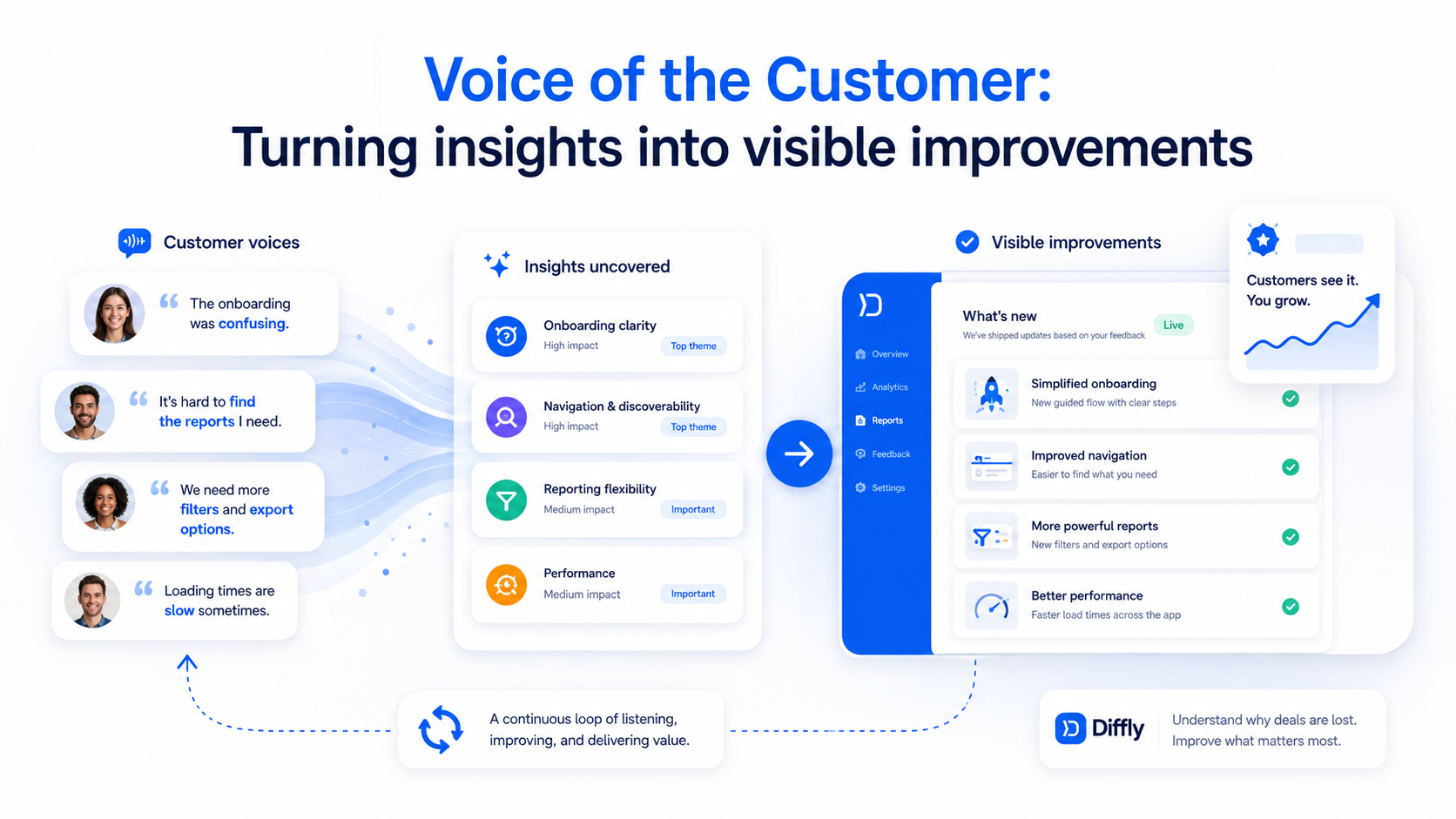
B2B SaaS companies are (finally) investing in the Voice of the Customer: better understanding the buying decision (why deals are won / lost) and the post-signature experience (why customers renew… or don’t). And that’s great news.
But in practice, the real challenge is not collecting feedback, it’s making it actionable, then turning it into visible decisions and actions, without falling back into internal biases or cross-team friction. This is precisely where structured programs (such as those offered by Diffly) create an advantage… provided the key success factors for activation are in place.
Why the best insights are not always enough ?
Even when data collection is solid and insights are clear, three realities come up again and again:
- Without a framework, insights can be re-biased (“we already know this,” “that’s not it,” “it’s because of…”) and trigger defensive debates rather than concrete decisions.
- The most structural issues live “between” teams: gray areas of ownership, handoffs, unresolved trade-offs between Sales ↔ Marketing ↔ Product ↔ CS.
- Time and governance are missing to turn a flow of feedback into priorities, team-level plans, and concrete updates (value messaging, roadmap, offer/contract policies, Sales/CS processes).
In other words, as much value lies in the decision framework and execution as in the data collection itself.
The ideal situation: when the conditions for success are met
When a VoC program performs well, the same ingredients are almost always present.
1) A clearly identified, legitimate, and cross-functional project lead
Not necessarily the most senior person, but someone able to:
- make teams work together (Sales / Product / Marketing / CS),
- establish an analysis and decision framework,
- arbitrate when things get stuck (or escalate arbitration).
2) A simple method that forces translation into action
An approach that avoids two classic pitfalls:
- accumulating observations without making choices,
- multiplying initiatives without coherence.
Concretely, this requires the ability to:
- isolate the “real problems” (not the symptoms),
- identify likely root causes,
- translate drivers into concrete changes (go-to-market, product, delivery, CS),
- prioritize explicitly (and own what will not be done).
3) Facilitation and execution discipline
Even a good plan remains just a plan if no one:
- maintains the sequence (preparation → workshops → deliverables),
- structures the readout (teams / leadership),
- secures execution (owners, timelines, indicators).
This is often where organizations drop off — not due to lack of intelligence… but due to lack of bandwidth, method, and coordination.
Key success factors by use case
Activation does not have the same requirements for every use case. Here are the elements that make the difference.
Use case 1: Win/Loss: improving go-to-market (without “romanticizing” losses)
Objective: turn buyer insights into concrete improvements in the sales cycle and positioning.
Specific success factors:
- a clearly defined scope (segment, offer, country, deal type) to avoid overly general and unusable conclusions,
- a readout designed to avoid bias (“we lost because of price”) and surface real causes (value perception, trust, differentiation, buying process…),
- the ability to translate drivers into value messaging, targeting/ICP, content, objection handling, and sales process improvements.
Use case 2 : Retention / renewal (the “must-have” before it’s too late)
Objective: capture renewal risk signals and reasons early enough to act.
Specific success factors:
- a systematic mechanism (not only after a “painful” churn),
- the ability to distinguish weak vs. strong signals in a denser flow than new business,
- conversion into business decisions (not just satisfaction observations): journeys/processes, offer/contract, go-to-market, and product roadmap.
Use case 3 : Upsell / Expansion: structuring growth on the installed base (without opportunistic actions)
Objective: turn the customer voice into concrete expansion levers (where to invest, for what outcome).
Specific success factors:
- a consolidated view of pain points and perceived value drivers (beyond scores),
- an arbitration logic: “where to focus energy” (accounts / use cases / entities / offers), rather than a list of “good ideas,”
- conversion into offer decisions: packaging, services, value messaging, and roadmap to make expansion obvious (and sellable) — not just “detecting opportunities.”
A simple framework to move from insight to impact
Without going into details, a robust approach generally follows three phases:
- Frame and choose: clarify challenges, reframe, assess impact, decide priority topics.
- Explain and design: analyze causes (not symptoms), build options, produce an initial action plan.
- Consolidate and arbitrate: finalize actions / owners / timelines / indicators, decide “what we do / don’t do.”
Between workshops, a significant part of the value lies in preparation, formalization (syntheses, backlog, team plans), and structuring decisions to accelerate alignment. (This is often what prevents momentum from dropping between sessions.)
What if the conditions are not met?
Two situations come up very frequently:
- A project lead exists, but the approach is new: support is needed to launch correctly (framework, method, neutrality, prioritization, readout).
- No project lead is available: the initiative remains fragile (no owner, no cross-functional coordination, no arbitration). In this case, temporarily externalizing facilitation and prioritization helps secure activation.
Conclusion: a Voice of the Customer translated into “win rate, retention, and expansion,” not just “measured”
The Voice of the Customer becomes a competitive advantage when it is:
- understood without bias,
- shared without blame,
- arbitrated without inertia,
- executed without silos.
If you need support to accelerate execution around a Diffly program — whether to launch the initiative, align multiple teams, or secure delivery — the simplest step is to discuss it.
Article written as part of the Diffly × Nouaison Conseil (B2B Go-to-Market & Customer Success Strategy and Execution), https://www.linkedin.com/in/jeremy-ghelardini-nouaison/

Richtext Templates

"Lorem ipsum dolor sit amet, consectetur adipiscing elit. Suspendisse varius enim in eros elementum tristique."
John Doe
Name, Role @Google

Analysing CRM data is a good 1st step but I know I only get 20% of the real story

Constance Morales
Constance Morales, Product Marketing Manager @ Scaleway