Summarize this article with:
Win-Loss Analysis: What your Product team can (and should) get out of it
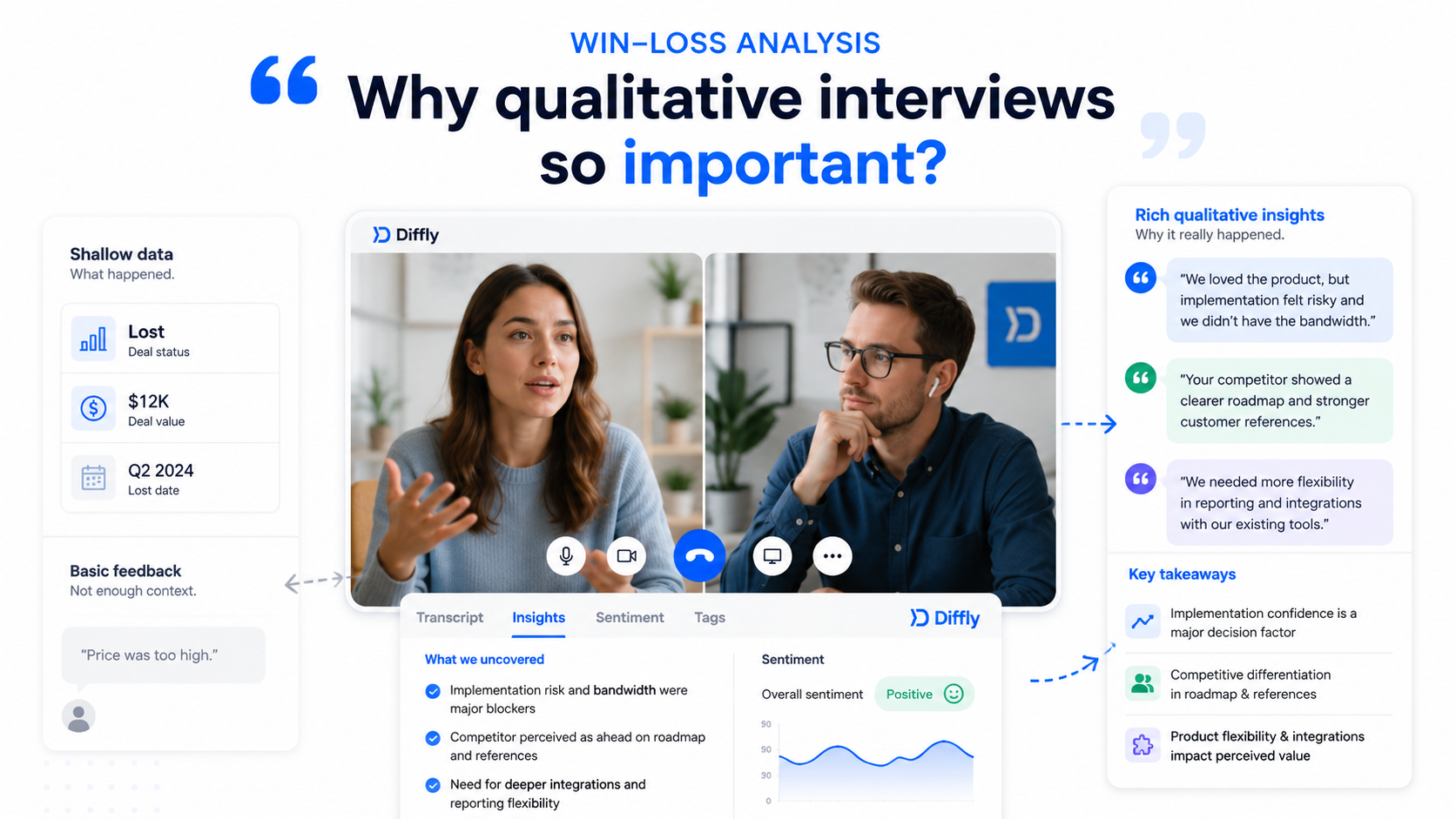
What is win-loss analysis? It's a method that consists of systematically interviewing won and lost prospects about the reasons behind their purchase decision. This method is often reserved for sales teams to keep an eye on the competition. Yet this same method generates signals that are highly valuable to Product: perceived complexity, how modern the interface feels, functional fit by segment. A Product team that taps into this unbiased feedback steers its roadmap with more precision than with a standard internal study, a concrete advantage for any company in a growth phase.
In most B2B companies, this practice originates on the sales side and stays locked there. Buyers are interviewed, the answers get compiled into a spreadsheet, the results are presented in a review meeting, and the exercise stops there. The work itself is often solid. The problem lies in its distribution: the levers it reveals never reach the right teams.
Field observation: specialized win-loss analysis solutions, like Klue or Primary Intelligence, exist precisely because most B2B companies fail to circulate this feedback beyond their sales teams. In practice, a lost deal generates on average several pages of interview notes, and what usually comes out of it is a single three-line summary shared in a sales review. The rest of the material (the part Product actually cares about) never leaves the CRM.
1. A practice historically limited to Sales
This practice originally served the competitive intelligence needs of sales teams. It still serves that purpose today. However, the data it generates has a much broader reach, one that remains largely underused.
Asking customers and prospects about their decision criteria reveals a raw, unfiltered perception, one not shaped by the biases inherent to the organization itself. The reason cited by a buyer who didn't convert rarely gets the chance to be shared as candidly by a loyal customer.
Here are three typical comments from this kind of interview:
- "Your interface felt dated to us": this comment points to a perceived barrier around the software's modernity.
- "Some features were unnecessary for our use case": this remark reveals a segmentation or packaging issue.
- "We never managed to get a clean demo going": this phrase signals friction in the onboarding process.
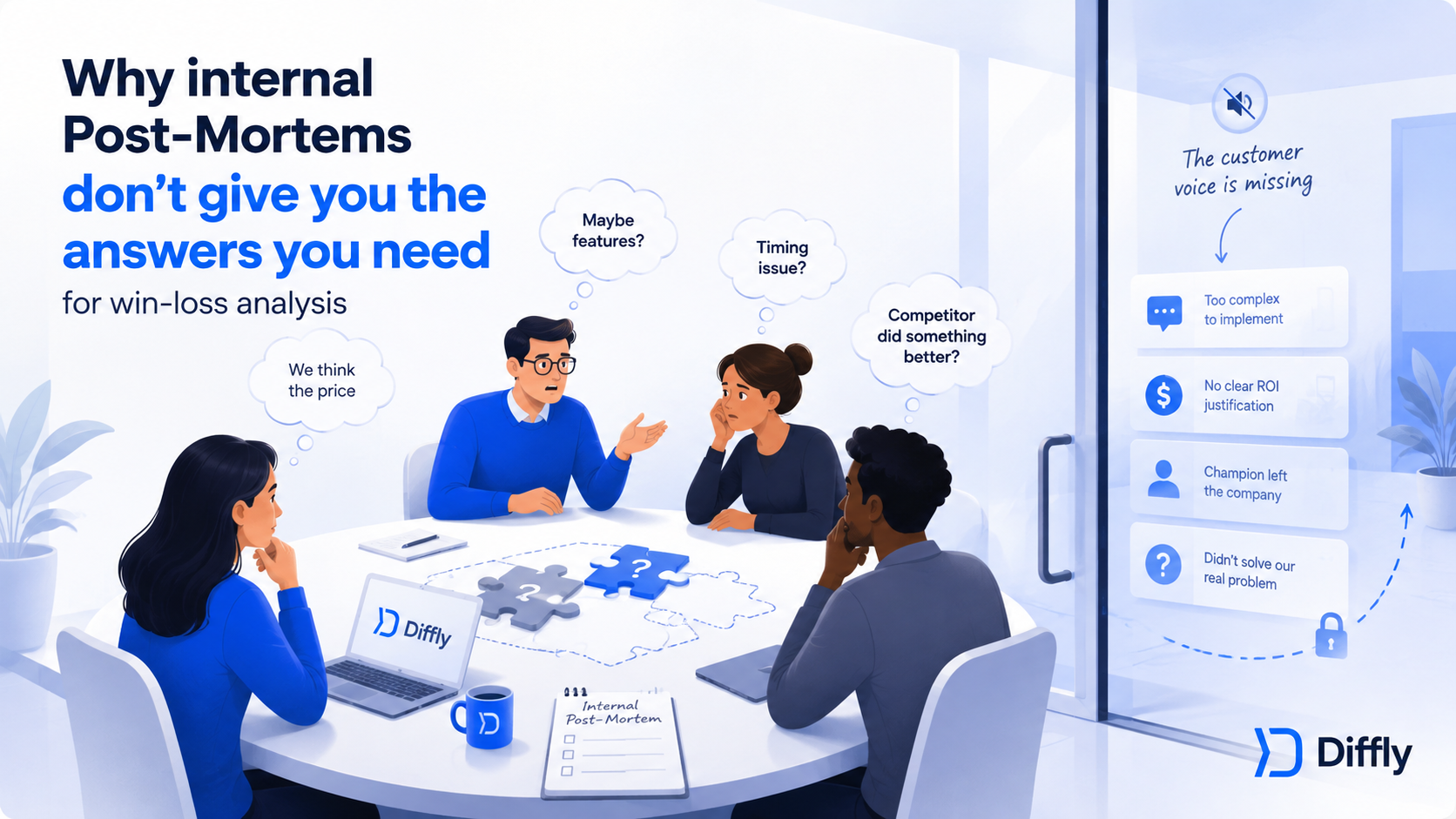
These aren't sales issues. They're Product issues, and this data almost never reaches the CPO. A sales summary condenses it and strips out its substance before it circulates. A company that relies on these summaries ends up arbitrating its roadmap on intuition rather than on verifiable market facts.
2. Three signals that should reach Product
Three broad types of feedback consistently emerge from these prospect interviews. The Product team remains best placed to turn these signals into concrete improvement areas.
2.1 Perceived complexity
A buyer rarely voices a direct criticism. The signal shows up indirectly, in various forms:
- "It took too much time to get up and running"
- "We couldn't get buy-in from our internal teams"
- "The learning curve scared us off"
These three sentences describe the same obstacle: adoption friction. Regularly tracking this type of feedback makes it possible to target precise actions: simplifying the activation journey, building documentation into the tool, redesigning onboarding.
Signals to watch for in the verbatims:
- Repeated mentions of time-to-value
- Unfavorable comparisons with a competitor perceived as "simpler" (a prospect evaluating your solution against a well-known market player, for instance HubSpot or Salesforce, often phrases this contrast in their own words)
- A sense that the tool is "overbuilt" relative to the actual need
2.2 Perceived modernity of the interface
Aesthetics function as a trust indicator. A buyer who describes an interface as "aging" is actually expressing doubt about the vendor's capacity to innovate, a factor that weighs on the purchase decision well beyond the design itself.
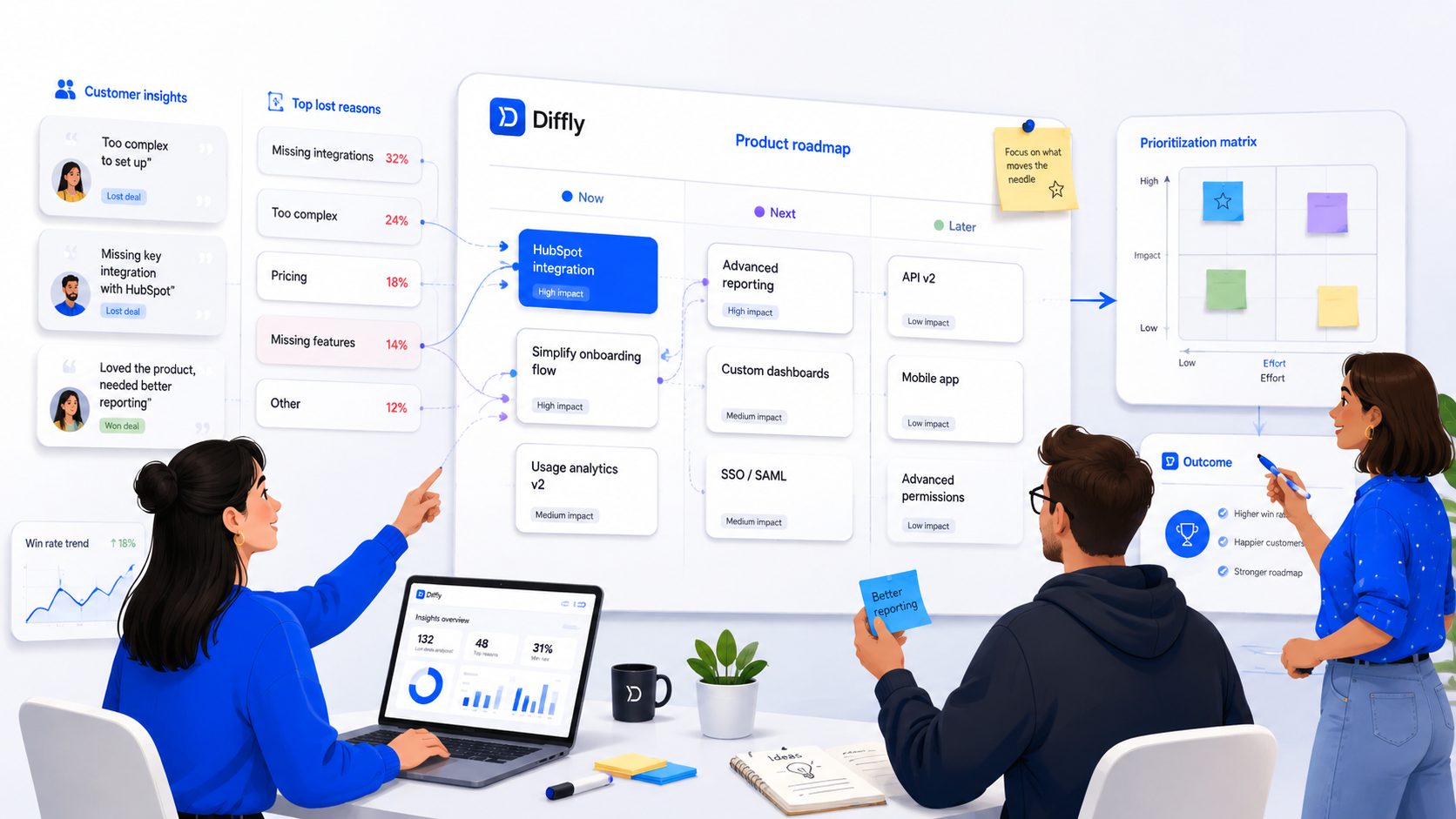
A product manager who catches this key signal adjusts the roadmap on a factual basis rather than on unverified intuition, a time-saver for the whole company.
2.3 Functional fit by segment
A feature designed for one customer segment can be perceived as unnecessary by another. This method reveals these mismatches with a precision that internal audits don't reach: it captures the perspective of prospects who evaluated the solution under real conditions, against competing alternatives, using their own decision criteria.
2.4 A concrete example
Take the typical case of an HR SaaS vendor losing a deal to a younger competitor. The interview reveals that the prospect never complained about price or features: they cited slow implementation, estimated at six weeks versus two at the competitor they chose instead. That same piece of feedback, condensed into one line in a sales CRM ("prospect found the implementation lengthy"), loses all its actionable value. Passed on as a full verbatim to the Product team, it becomes a key argument for prioritizing a self-service onboarding initiative in the next quarter.
3. One method among others, not a universal tool
Presenting this approach as sufficient on its own would be misleading. It fits into an ecosystem of complementary methods, each with a different cost, frequency, and depth of analysis.
Comparison by value:
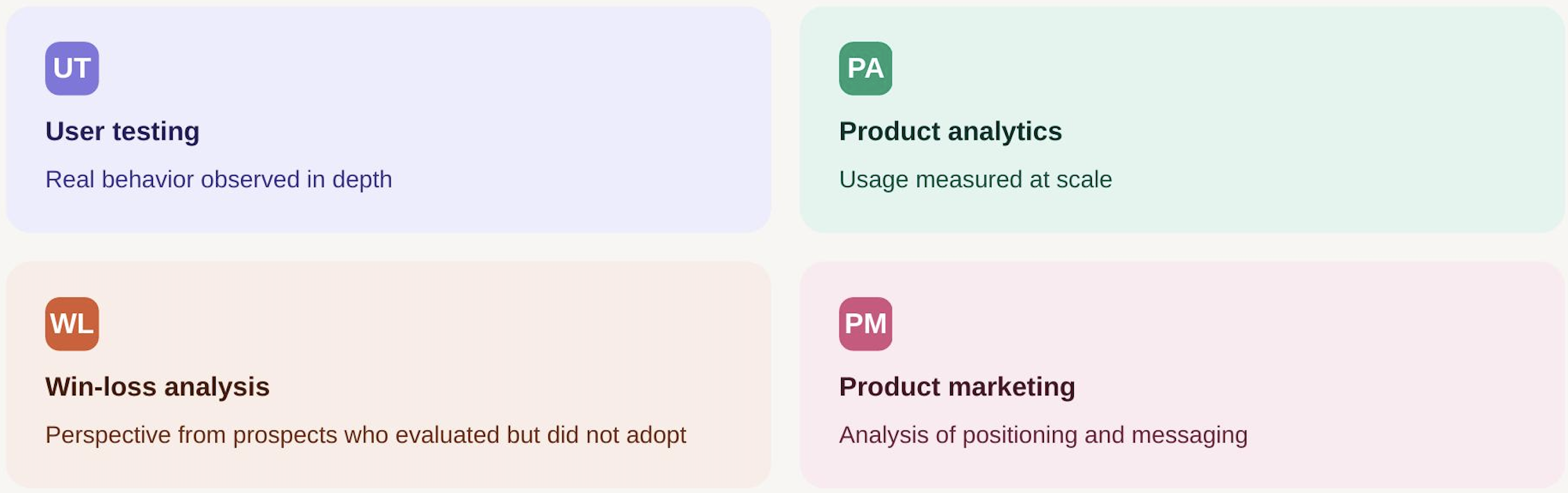
Comparison by measurable criteria:

What this approach brings remains unique: the perspective of prospects who evaluated a solution without adopting it. Neither an active customer nor a buyer still mid-decision, this distance makes their feedback particularly valuable.
4. Organizing the flow of feedback to Product
Conducting win-loss interviews is one step in the sales cycle. Getting the right signal to the right place is a second, distinct one. Three pitfalls come up most often in B2B organizations.
Step one: get the feedback out of sales-only materials. A resource that stays confined to Sales will never be looked at by Product. An organization needs to define who receives what, in what format, and at what cadence.
Step two: pass on the verbatim, not the summary. Feedback loses the bulk of its value once it's condensed. The sentence "The buyer found the solution too complex" doesn't carry the weight of: "The team spent three weeks in evaluation and never managed to get through a complete demo." A raw verbatim lets you qualify a signal; a summary only allows for an approximate rephrasing.
Step three: increase interview frequency. A quarterly summary may be enough for an annual sales strategy. It isn't enough for a team that needs to tell a one-off irritant apart from a recurring structural problem.
5. How Diffly automates this loop
Most B2B companies don't struggle with data collection. The struggle is in structuring it and getting it to the right teams. Diffly automates the collection and analysis of win-loss interviews, then centralizes the verbatims in a form directly usable by Product, without the product manager having to dig them out of a CRM or a shared folder themselves.
The result: decisions grounded in market facts rather than internal intuition.
FAQ: Product and lost deals
Is this approach useful without a dedicated team?Yes. Running a few interviews per quarter on lost deals is already enough to collect actionable data on buyers' decision criteria, even without a structured program.
Who should run these interviews: Sales or Product Marketing?A neutral third party (Product Marketing, or a dedicated tool like Diffly) ensures objective feedback. This neutrality then makes it easier to align sales and product teams.
How often should these interviews be conducted?A monthly or bimonthly cadence, complemented by a quarterly summary for major decisions, provides signals that are reliable enough without overloading teams.
Which deals should be prioritized in the analysis?Deals lost to your two or three main competitors, as well as those lost in strategic customer segments, reveal the most improvement opportunities on the product side.

Richtext Templates

"Lorem ipsum dolor sit amet, consectetur adipiscing elit. Suspendisse varius enim in eros elementum tristique."
John Doe
Name, Role @Google

Analysing CRM data is a good 1st step but I know I only get 20% of the real story

Constance Morales
Constance Morales, Product Marketing Manager @ Scaleway