Summarize this article with:
A Battle Card compares your offering to a competitor's to prepare for a sales meeting. It becomes outdated because it rests on a single source: what your sales reps have seen in the field. That foundation misses a large number of situations where a competitor wins without ever crossing paths with your team. The problem isn't the quality of the card, it's the source that feeds it.
Where does a Battle Card's information actually come from?
A sales rep goes up against a competitor, notes what was said, and the information makes its way back to the team. That's a useful source, but its scope stays narrow. It covers only the deals where your company was present.
A deal won by a competitor without any consultation leaves no trace. An internal comparison at the buyer's company never reaches the team. A card built on this foundation ignores an entire slice of market reality, until a typical customer comes back with a point you never knew about.
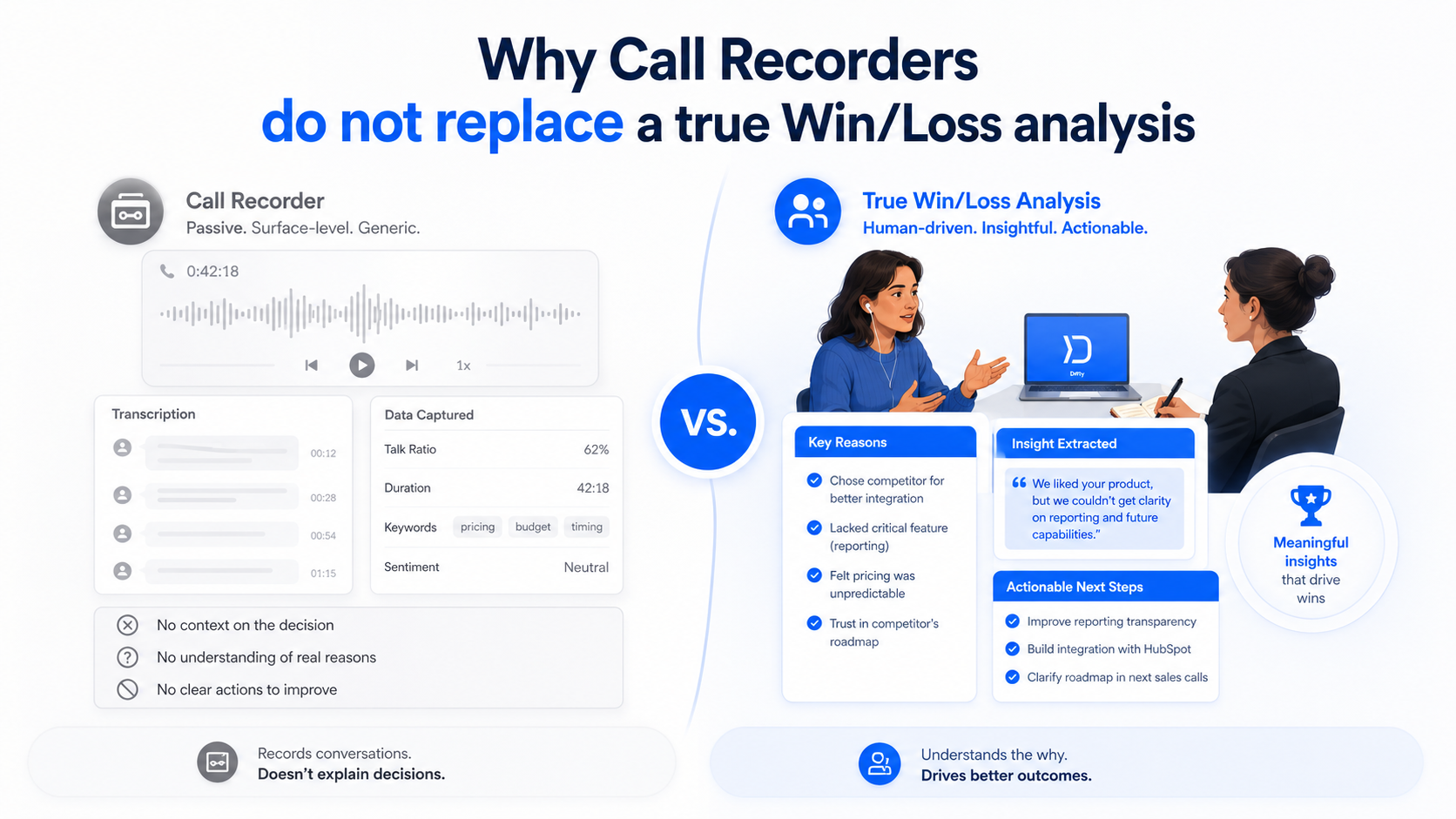
According to Clozd, a firm specialized in win-loss analysis, the loss reasons logged by sales reps and the real reasons given by the buyer only align in 15% of cases. The Battle Card built on the CRM tells a different story than the one the prospect actually experienced.
The three blind spots that make your competitor card unreliable
A Battle Card built solely on field feedback misses three types of situations.
1. Deal won by a competitor without any consultation
Concrete example: the prospect chooses a competitor without ever opening a conversation with you.
Impact on the Battle Card: the deal never enters the CRM, the card ignores this path.
Source: Diffly Keynote 2026, Arnaud Le Gay (Oracle): 51% of deals lost by Oracle were lost without Oracle being present.
2. Internal comparison at the buyer's company
Concrete example: your offering is mentioned in a meeting, then dismissed within minutes.
Impact on the Battle Card: no sales trace, no signal reaches the team.
Source: field observation, not quantified to date.
3. Indirect competitor (status quo, in-house build)
Concrete example: the budget goes to another priority or a product built in-house.
Impact on the Battle Card: often the biggest competitor by volume across a large number of companies, absent from the card.
Source: Forrester (2019): 60% of pipeline deals end with no decision rather than facing an identified competitor.
The common thread across these three blind spots is easy to grasp. Each has a different cause, but the consequence stays the same. Your card only sees the part of the market where you were already involved.
What is a Battle Card's real objective?
The objective of a Battle Card is simple to explain, but often poorly framed. It isn't about listing the maximum number of points against a competitor. It's about giving a sales rep the best possible answer at the right moment, with accurate, dated information. A good Battle Card doesn't describe the competition in general, it describes one specific competitor against one specific need. The buyer doesn't need to buy at the best price, they need the best answer to their problem.
A Battle Card serves three audiences at once. The sales team uses it before a meeting to prepare its response. The marketing team uses it to adjust a proposal. The prospecting team draws on it to qualify a prospect before the first call.
When the card no longer serves this purpose, the problem isn't immediately visible. A rep keeps using it, a prospect asks a specific question about a competitor, and the answer given no longer matches reality. The prospect knows it. The rep doesn't.
Why does a Battle Card go stale without any visible warning?
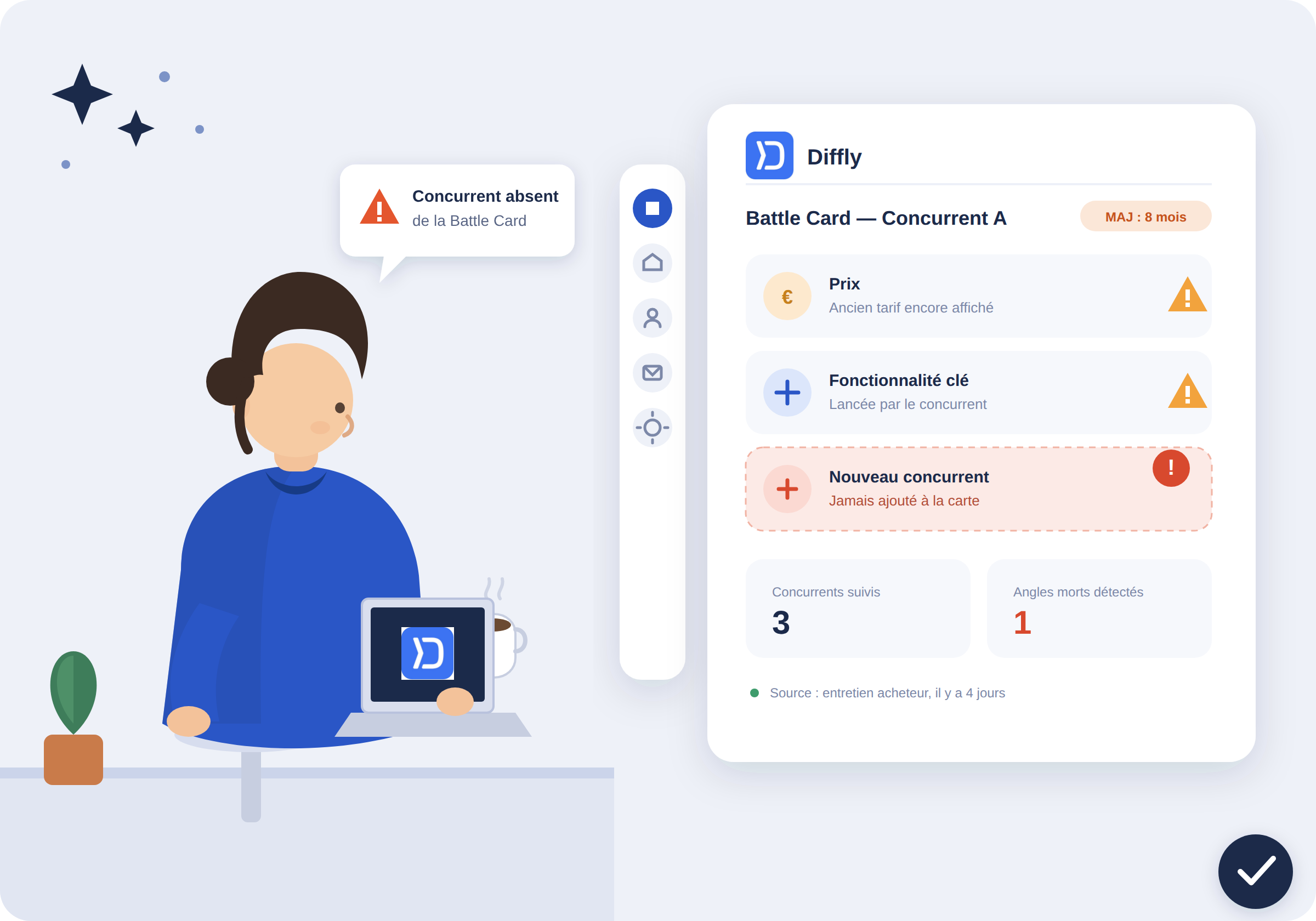
A Battle Card never displays an error, unlike a broken link or a dashboard that goes down. Three drifts happen silently, and each deserves attention.
The competitor changes its pricing grid
The card still shows the old price, and no one goes back to check. The competitor lowered its price. The point "we're cheaper" becomes false without anything flagging it.
The competitor ships the feature that used to be its weak point
The competitor now offers what it didn't offer before, and the point most used by your reps becomes false overnight. The prospect knows it at the moment of purchase, the rep doesn't. What disappears in that instant isn't just that point, it's credibility for the rest of the conversation.
A new entrant appears on the market
Reps discover it one by one, each on their own, without the information ever being centralized in the card. The team keeps preparing for meetings against the same three competitors while a fourth player is out there signing contracts.
The drift is never sudden. The card becomes wrong little by little, while the whole team keeps using it as if it were still up to date.
Who can actually keep a Battle Card up to date?
The buyer, and only the buyer, has the complete view needed to correct a Battle Card.
Sales reps have a partial view by design. They're focused on the action, not on stepping back. A card built on the CRM stays built on what the team saw, not on what actually happened at the prospect's company.
The buyer, on the other hand, holds information no one on the sales side has: they saw the entire process. They know who they consulted, in what order, on which specific criteria they compared the offers, and what reassured them about the competitor they chose. They also know why they never opened the conversation with your team, when that's what happened.
The rep who lost the deal never gets that answer directly. Facing them, the buyer stays polite and gives a simplified version. Facing a neutral third party, with no commercial stake, a few weeks later, they explain what really happened. That difference in posture is what makes it possible to recover the missing information.
How to build a reliable Battle Card by relying on buyers
Four rules work in practice to keep a card reliable over time.
1. Feed the card continuously rather than through an annual campaign
An annual review produces a frozen snapshot. A steady stream of buyer interviews produces a trend, and it's that trend which warns you a competitor is gaining ground over time.
Creating a Battle Card is a one-time action. Updating it is a routine, on a monthly rather than annual cadence, with less total work than redoing everything from scratch every year.
2. Separate what the team knows from what it assumes
Every line on the card should carry a source and a date. A line without a dated source remains a hypothesis, and should never be treated as an established fact in front of a prospect.
A simple example: "the competitor lowered its price, field source, one occurrence in June" doesn't carry the same weight as a fact confirmed by ten buyer interviews over the same period. The first line is a signal to verify. The second is a foundation a rep can answer from with precision.
3. Add a column for competitors you've never faced
The status quo, an in-house build, budget priority given to another project: these choices are real for the buyer, even if they don't look like a classic competitor.
A complete card also documents what the buyer chose instead of your offering, including when that choice involved no direct competitor in the usual sense of the term. This column is missing from most existing cards.
4. Capture raw verbatims, not summaries
A sales rep remembers the exact phrase a buyer said. They generally don't see the rewording that later gets applied for marketing content.
"The competitor is cheaper" and "we compared prices over a year and chose the cheaper one" don't carry the same information. The first sentence stays vague. The second reveals the real decision criterion, with a level of precision that genuinely helps a rep respond accurately.
How to structure a Battle Card that's simple to use
A good card doesn't try to say everything. It puts the most relevant information in the right place, in a format that can be scanned in seconds before a meeting.
Four elements are enough to structure a useful card: the main positioning against the competitor, the three questions most frequently asked by a prospect, the source and date behind each claim, and a dedicated column for indirect competitors. A more complex template doesn't help a rep in a hurry before a call, because the important information gets diluted.
The goal isn't to keep adding endless extensions, but to keep a short, current, verified foundation.
Key takeaways
A Battle Card built solely on field feedback describes the market as sales reps saw it, not as it actually is. That gap stays invisible in the CRM and grows every year.
Only the buyer can close that gap. Updating a competitor card means talking to buyers who chose a competitor, or no competitor at all, documenting what really happened, and giving that reality to the sales team instead of a document frozen once a year.
A Battle Card remains a simple document. The method that feeds it makes all the difference between a reliable tool and a tool that reassures you wrongly.
FAQ
How often should a Battle Card be updated to stay reliable?
Continuously rather than through campaigns. An annual review delivers a snapshot that's already outdated the moment it's published. A monthly stream of buyer interviews flags competitive shifts as they happen.
Can a B2B Battle Card be based solely on the CRM?
No. The CRM misses deals with no consultation, internal comparisons at the buyer's company, and indirect competitors like the status quo. According to Forrester, these blind spots affect up to 60% of pipeline deals.
How do you build a Battle Card that actually helps sales reps?
By separating what the team knows from what it assumes, with a source and a date on every line. By collecting exact verbatims rather than summaries, fed continuously through buyer interviews.
Who should keep a Battle Card updated after it's created?
A neutral third party, never the rep who worked the deal in question. Facing the seller, the buyer stays polite. Facing a third party with no commercial stake, they explain what really happened.
How do you recover information about a competitor after a lost deal?
By asking the buyer, a few weeks later, through an interview conducted by someone outside the deal. It's the only way to get a complete account rather than a simplified version given out of politeness.

Richtext Templates

"Lorem ipsum dolor sit amet, consectetur adipiscing elit. Suspendisse varius enim in eros elementum tristique."
John Doe
Name, Role @Google

Analysing CRM data is a good 1st step but I know I only get 20% of the real story

Constance Morales
Constance Morales, Product Marketing Manager @ Scaleway