Summarize this article with:
A win-loss report is the write-up of interviews conducted with your won and lost buyers. This report most often takes the form of a single, exhaustive document sent to a broad distribution list. That is the main reason it goes unread. The problem does not lie in the quality of the interviews; it lies in the addressing.
Understanding what each function expects from a report matters more than improving the collected material itself. Structuring each write-up around that basis, rather than on a single template, is the key to everything else: it changes the kind of reading each person does, week after week.
According to Forrester ("Sales Content: It's Time for an Overhaul"), 65% of internally produced sales content is never used by sales teams, for lack of precise addressing. The same mechanism applies here: buyers themselves spend only 17% of their total buying time in direct contact with a supplier, according to Gartner, which makes every minute spent reading this document all the more valuable not to waste on poorly targeted content.
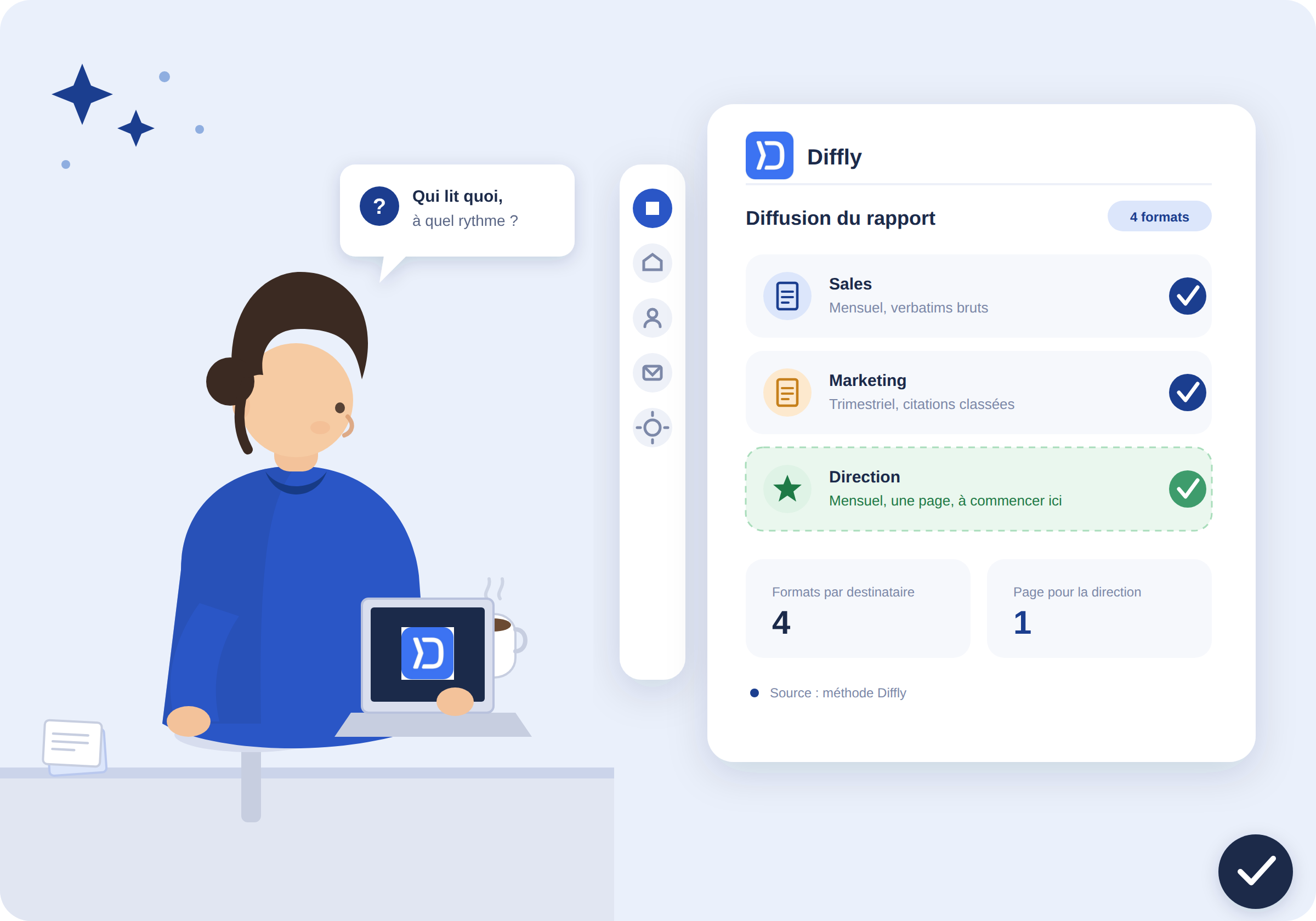
The four formats at a glance
Sales
Frequency: monthly
Format: 1 to 2 pages, raw verbatims
Main content: objections and arguments by segment and by competitor
Marketing
Frequency: quarterly
Format: collection of quotes
Main content: gap between the message sent and the message understood, sorted by theme
Roadmap (product)
Frequency: quarterly
Format: prioritized list
Main content: feature gaps ranked by amount at stake, not by number of requests
Leadership
Frequency: monthly
Format: one page
Main content: where the company wins, where it loses, against whom, and the implication for resource allocation
Why doesn't a single report work?
Because it forces every reader to sort through the entire body of material themselves, and almost no one does.
A salesperson who opens a forty-page document where only three pages are relevant to them will not open it again the following month. Someone on the roadmap side looking for feature gaps in the middle of a competitive analysis gives up by the second section.
Everyone needs a concrete fraction of the collected material, and that fraction is never the same from one function to the next.
What should the report for sales contain?
What blocks deals at closing, broken down by segment and by competitor, in one to two pages.
Useful content: the objections actually encountered during the sales cycle, the arguments that worked for the competitor who won the deal, the committee configurations that lower the chances of winning.
Monthly frequency. Beyond that, the connection to ongoing deals is lost.
Required format: raw verbatims. A salesperson remembers a buyer's exact words and disregards a rephrasing, however faithful it may be.
What should the report for marketing contain?
The gap between the message sent and the message understood by the market, in the form of quotes sorted by theme.
This is the most underused read, and one of the most profitable to put in place.
The useful format is not a summary but a collection of verbatims: the vocabulary buyers use to describe their problem, compared to the vocabulary used on your pages and in your offers.
Quarterly frequency. Messaging is not rewritten every month, and it takes volume to distinguish a recurring signal from an isolated anecdote.
What should the report for product contain?
The gaps that cause deals to be lost, prioritized by amount at stake rather than by number of requests.
This is not the same thing as the pain points reported by current users. A missing feature cited in three high-value losses does not carry the same weight as a pain point flagged by fifteen existing customers.
It is this crossing of financial impact and frequency that actually moves the roadmap, because it quantifies the stakes instead of simply counting requests.
What should the report for leadership contain?
One page. Where you win, where you lose, against whom, and what that implies for resource allocation in the following quarter.
Leadership does not need the interview details. Leadership needs to know whether the assumptions underlying the company's objectives still hold, or whether a point of concern requires a decision.
Which report should you start with?
The one for leadership, for two reasons.
- It is the one that funds what comes next. A program that never reaches the level of executive decisions remains just another tool in the salesperson's toolbox, and it disappears at the first budget review.
- It is the one that legitimizes the other three. Once leadership steers with this data, the relevant teams take it up naturally, without it needing to be imposed.
Sophie Peyrat-Forestier (Lucca) illustrated this reach at the Diffly Keynote 2026: it was by listening to the voice of the German market that the company understood what was blocking its local product-market fit, a decision that went well beyond the sales scope and that redefined part of its English and German strategy.
What method should you apply to create a report format?
A report is built around an identified decision, not an audience.
Before creating a format, ask the simple question: what decision does this person make every month, and what do they need in order to make it better?
Without a clear answer to that question, the report will not be read. Not because it is poorly made, but because it has no identified use.
How do you ensure these reports remain reliable over time?
One methodological point determines the value of every format: the interview sample must stay balanced between won and lost deals, and be conducted by a third party rather than by the salesperson responsible for the deal.
An unbalanced sample, built solely from lost deals, biases the diagnosis toward weaknesses and hides the criteria that lead to wins. The most effective process is to collect interviews continuously, one by one, rather than organizing a single, isolated large-scale campaign.
The profile of the people interviewed must also be defined in advance; otherwise, the pattern that emerges mainly reflects who was willing to respond, not a real deciding factor. A common failure is to conduct detailed interviews only in isolated bursts, instead of continuously feeding the program: the recurring reason then becomes visible too late to act on, and the previous quarter's assessment arrives after the opportunity has already been lost a second time for the same reason. Identifying this underperformance factor before an actual customer raises it remains the best lever for success for a win-loss program. This work also makes it possible to analyze and explain, deal after deal, why the same reason keeps coming up. Structuring this process from the outset avoids having to rebuild it with every new program.
How do you actually put these formats in place?
Putting these four formats in place does not require a new tool or a long project, and takes little time once the method has been chosen. A short guide, written in English or French as needed, to share with each team, is enough to get started: define the frequency, choose a concrete example for each stage of the sales cycle, and give everyone a common base to use and refer back to. The rollout itself fits into a short phase, led by the person already conducting the interviews, before progressively covering all four recipients. This rollout is not a heavy undertaking: it is a quick project, not a year-long effort, and the most useful action is often the simplest to decide on. A battlecard tool such as Klue or Crayon can help distribute the sales format once it exists, but sorting by recipient remains a job in its own right.
A well-targeted report can lead to reworking an entire roadmap, and can boost the effectiveness of the whole program by turning it into a genuine lever for continuous improvement: it is no longer a simple archive to read once, nor an analysis filed away in a drawer, but a reading grid that helps every lost prospect become an analyzed signal rather than a silent failure that gets forgotten. Such a change may require a concrete demonstration to the teams, not a new promise, in order to avoid losing the same opportunity twice and to make each quarter's outcome better than the previous one.
What to remember
This type of program generates either documentation or decisions, depending on how it is delivered. The difference lies in the breakdown by recipient, with a format and frequency suited to what each person actually decides, week after week.
FAQ
How often should these reports be delivered?
Monthly for sales, quarterly for the roadmap, monthly in a one-pager for leadership. The full detail of the four formats is given in the table above.
Who should receive this report as a priority?
Leadership. They are the ones who decide on resource allocation, and it is this report that legitimizes and funds the rest of the program.
Should you distribute raw verbatims or a summary?
Raw verbatims for sales and marketing, a prioritized summary for the roadmap and leadership. A buyer's exact words carry more information than a rephrasing.
Does this type of report replace a market study?
No. A market study describes potential demand in general terms. Win-loss explains real purchasing decisions already made on your own deals. The two answer different questions and complement each other.

Richtext Templates

"Lorem ipsum dolor sit amet, consectetur adipiscing elit. Suspendisse varius enim in eros elementum tristique."
John Doe
Name, Role @Google

Analysing CRM data is a good 1st step but I know I only get 20% of the real story

Constance Morales
Constance Morales, Product Marketing Manager @ Scaleway