Summarize this article with:
The cost of a lost deal is usually estimated at the amount of the opportunity, sometimes with the sales time invested in the pipeline added on top. That calculation is correct and very incomplete. The real cost isn't measured on that opportunity, it's measured on the ones that follow, and it breaks down into four categories, three of which remain invisible in most sales dashboards.
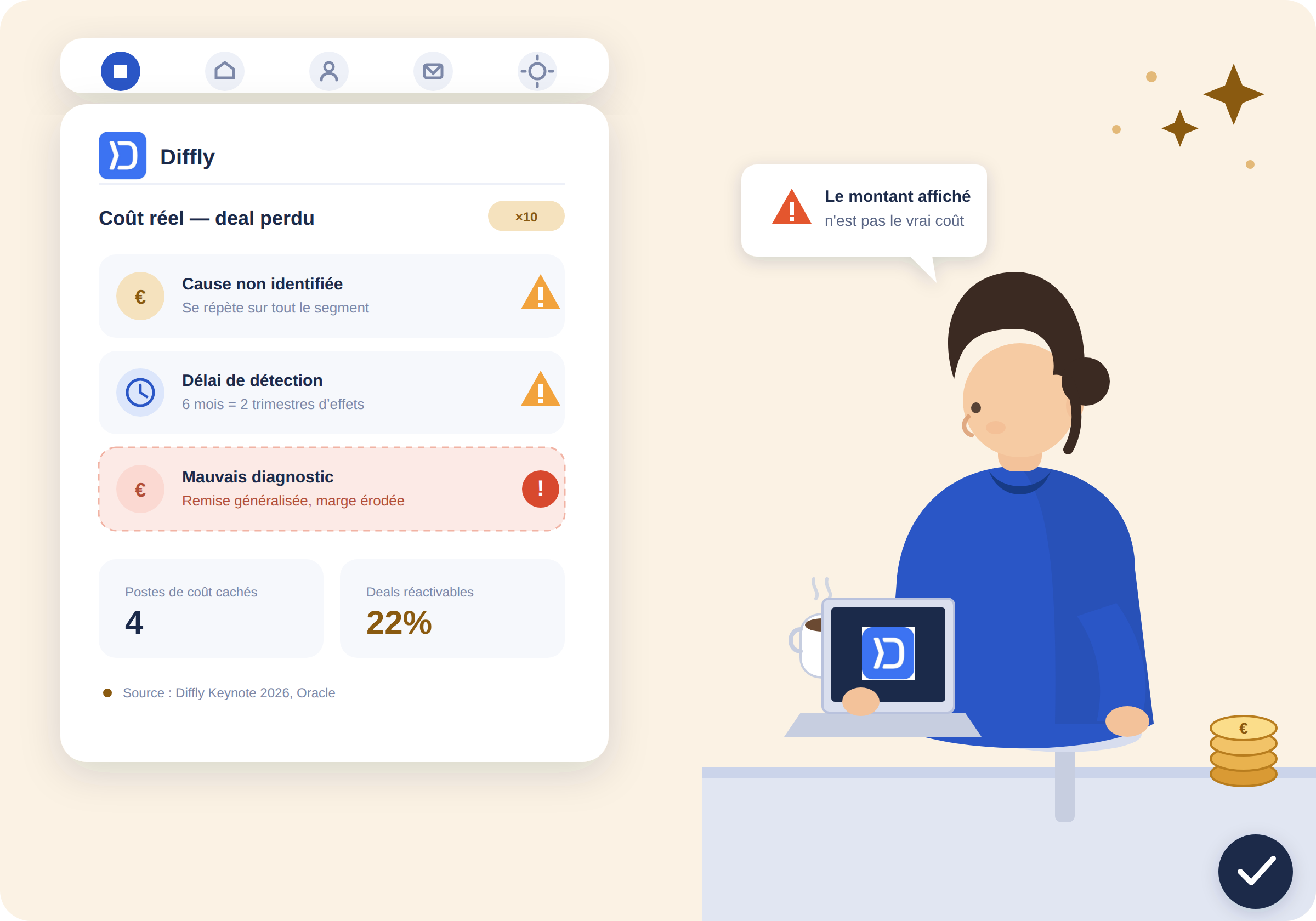
The four cost categories at a glance
1. Unidentified cause
Description: the real cause is never corrected and keeps producing the same effect on comparable deals
Financial impact: multiplies by the number of deals in the same segment
Numerical example: a cause affecting 1 deal in 5 out of 50 opportunities costs 10 lost deals, not 1
2. Problem detected too late
Description: the cost comes from the detection delay, not from the time needed for the fix itself
Financial impact: equivalent to several quarters of cumulative effects
Numerical example: a messaging mismatch undetected for 6 months means two quarters of poorly targeted campaigns
3. Decision based on a wrong diagnosis
Description: a blanket correction (e.g. a discount) applied based on a misunderstood standard field
Financial impact: erodes margin across the entire segment, including deals won at full price
Numerical example: 84% of lost deals classified as "No Business Opportunity" in the CRM (Diffly Keynote 2026)
4. Paused pipeline never reopened
Description: paused deals are indistinguishable from dead deals without follow-up
Financial impact: cost of still-reactivatable deals never followed up on
Numerical example: 22% of lost deals are reactivated within 12 months on programs run by Diffly
Why isn't the amount of a lost deal enough to calculate its real cost?
A salesperson who loses a deal notes the opportunity's amount and closes the file. That figure already exists in the CRM; it requires no additional calculation. The problem isn't that it's wrong, it's that it's incomplete: it ignores what happens next, on the following prospects in the same segment, at the same pipeline stages, with the same salesperson or another one.
Category 1: how much does an unidentified loss cause cost?
An unidentified cause is the heaviest cost category, and its cost is calculated by multiplication.
If the real cause hasn't been identified, it hasn't been corrected. It stays in place and produces the same effect on all comparable deals, at the same pipeline stage.
Take a cause that affects one deal in five in a given segment. Over a period with fifty opportunities in that segment, that's not one lost deal, it's ten.
The first one cost you its amount. The next nine cost you the fact that you never looked.
The mechanism is silent, because each lost deal taken in isolation has a plausible explanation for the salesperson who experienced it. The recurring pattern only appears when aggregating dozens of interviews, deal by deal. According to Forrester Sales Research (2019), 60% of B2B pipeline deals end in no decision rather than a loss to an identified competitor — a cause that, if unidentified in a CRM like Salesforce or HubSpot, silently repeats across an entire segment. B2B buyers themselves spend only 17% of their total buying time in direct contact with potential suppliers according to Gartner, which explains why most of the real reasons stay out of the salesperson's view.
Category 2: how much does a problem detected six months too late cost?
A problem detected six months too late costs six months of effects, not the time needed for the fix.
A messaging mismatch detected late means two quarters of campaigns attracting the wrong prospect profiles, leads requalified by hand, and meetings that go nowhere because expectations were miscalibrated from the very first contact.
The fix itself often takes just a few days. The cost is in the detection delay.
This is what makes a continuous program worth more than an annual audit. The audit tells you what happened on the pipeline. The ongoing flow warns you while it's happening. A B2B sales cycle today lasts 6.5 months on average, up from 4.9 months in 2019 according to Ebsta: an undetected mismatch over that span can therefore affect two full sales cycles before it gets corrected.
Category 3: how much does a decision based on a wrong diagnosis cost?
A decision based on a wrong diagnosis turns a one-off failure into structural damage across the entire margin.
The classic case: the CRM shows price as the top reason for loss, and management decides on a blanket discount across the segment. According to Clozd (2025 State of Win-Loss Report), 85% of loss reasons recorded in a CRM do not match the real reason given by the buyer, which makes this kind of decision especially risky.
But "price" doesn't mean "too expensive" in a significant share of cases. It means "I didn't understand what I was paying for," or "I couldn't defend the spend internally against other decision-makers," or "the perceived risk outweighed the perceived gain."
None of these three problems is solved with a discount.
The result: margin drops across the entire segment, including on deals you would have closed at full price, and the real cause stays in place for the next sales cycle. The mechanism works both ways: according to McKinsey ("The Hidden Power of Pricing"), a 1% price increase translates on average into an 8.7% increase in operating profit, at constant volume. A blanket discount therefore weighs on margin far out of proportion to the discount percentage itself.
This risk is even greater when the starting data is unreliable. At the 2026 Diffly Keynote, Arnaud Le Gay (Oracle) noted that 84% of lost deals are classified as "No Business Opportunity" in CRMs — a field filled in by the salesperson to close the opportunity and move on to the next deal, not to capture the real reason.
Category 4: how much does a pipeline you never reopen cost?
A pipeline you never reopen costs you the value of paused deals that no one distinguishes from dead ones.
Some deals classified as lost aren't lost for good. Budget postponed rather than refused, a sponsor changing roles, a competitor selected whose rollout goes sideways. On programs run by Diffly, 22% of lost deals are reactivated within the following twelve months.
Without information, these situations are indistinguishable from definitive refusals inside the pipeline. No one follows up, for lack of knowing who to follow up with and when.
A thirty-minute conversation is often enough to settle it, and a well-timed follow-up remains cheaper than acquiring an equivalent prospect.
At which pipeline stage are the most deals lost?
A B2B pipeline breaks down into a few simple stages: booking the meeting, qualification, sending the proposal, then closing. The real cost of a lost deal changes depending on the stage at which it drops out of the pipeline.
A deal lost before the first meeting costs little: a few hours of prospecting on that prospect, nothing more. Losing an opportunity after a proposal has been sent costs far more: several weeks of sales work, a costed proposal built specifically for that prospect, and often a budget already mobilized on the client side.
The further a deal advances in the pipeline before being lost, the more its real cost exceeds its stated amount. Losing a deal right before closing, after several meetings and a detailed proposal, costs on average far more than a deal lost at the qualification stage, for the same initial amount.
This is why tracking, deal by deal, the pipeline stage at which each one exits changes how you read the total cost of B2B sales. Two companies with the same number of lost deals and the same cumulative amount can have very different real costs, depending on whether their lost deals cluster early (qualification, first meeting) or late (proposal, closing) in the sales cycle.
A final meeting where the prospect never intended to sign, for lack of a well-timed follow-up on a paused deal, illustrates this same gap between stated amount and real cost: the prospect was counted as lost, when a targeted follow-up would have been enough to reopen the deal.
What tool should you use to track this cost over time?
A spreadsheet is enough for a first one-off estimate of the average cost per lost deal. It quickly becomes insufficient once the volume of lost deals exceeds a few dozen per quarter, because the real work isn't counting, it's identifying the real cause behind the CRM field.
A dedicated win-loss tracking tool centralizes interviews, verbatims, and real causes, deal by deal, rather than an aggregated number with no detail. It's this tool, not a simple pipeline export, that lets you connect a recurring cause behind a lost deal to its real cost across multiple salespeople and multiple months, and trigger a follow-up on paused deals at the right time.
Can poor upstream qualification explain a lost deal?
Yes, and it's a classic blind spot in cost calculations: some lost deals should never have entered the pipeline in that form.
A poorly qualified prospect at the start of the sales cycle still advances through the pipeline stages, because no formal qualification method settled the matter at the first meeting. The risk grows with the size of the buying committee: according to Gartner, that committee now averages between 8 and 13 stakeholders, up from 5.4 in 2015, leaving more room for a poorly verified need upstream. Frameworks like BANT or MEDDIC exist precisely for this: they force the salesperson to verify the prospect's budget, decision-making authority, and timeline before investing several weeks of sales work and a costed proposal in a deal that wasn't ready.
A poorly qualified deal consumes the same sales resources as a qualified opportunity, all the way to closing or failure. The difference shows up in the closing rate by pipeline stage: a marked gap between two salespeople in the same segment often signals a difference in upstream qualification, not a difference in closing talent.
What mistakes distort the calculation of a lost deal's cost?
Three mistakes come up most often, regardless of industry.
- Counting only the direct amount. This approach ignores the other three cost categories and systematically underestimates the real cost to the business.
- Relying on a generic reason logged in the sales tool. A field like "price" or "No Business Opportunity" closes the deal without explaining the prospect's real decision.
- Treating each lost deal in isolation. An isolated misjudgment corrects itself, but a recurring pattern only becomes visible when comparing multiple deals in the same segment.
These three mistakes share one thing in common: they treat the cost of a lost deal as a fixed number rather than as a signal to investigate, salesperson by salesperson and segment by segment.
How do you calculate this cost in your own company?
Four figures are enough for a first estimate.
- The number of opportunities lost over the period and their cumulative amount. This is the direct cost, the only one you already know.
- The share of these lost deals whose cause you can explain beyond a hunch. At most companies, this figure is very low.
- Your current closing rate by segment, and the value of one additional point on your pipeline. This is the potential gain from a fix.
- The acquisition cost of a volume of prospects equivalent to that closing-rate point. This is the comparison point that makes the trade-off obvious for sales leadership.
On most B2B pipelines, gaining two points of closing rate costs less than generating ten percent more prospects, and the effect lasts longer across subsequent sales cycles. The average acquisition cost of a qualified prospect, compared with the average cost of a process fix, generally settles the debate in a few minutes for sales leadership.
Key takeaway
A lost deal doesn't cost its stated amount. It costs every subsequent deal lost for the same reason in the same segment, plus decisions made on a wrong diagnosis, plus paused deals never followed up on for lack of sales budget dedicated to follow-through. The only way out of this cycle is knowing why you're losing, not assuming it from a standard CRM field.
FAQ
How do you calculate the cost of a lost deal?
Add up four categories: the direct amount, the repetition cost of an uncorrected cause, the cost of the detection delay, and the value of paused pipeline never followed up on. The direct amount is generally the smallest of the four.
Is win-loss analysis worthwhile for a small or mid-size business?
Profitability depends on the volume of opportunities in the pipeline, not on company size. As soon as the same loss cause repeats across several deals in the same segment, the fix pays for itself many times over.
Should you lower your prices when the CRM points to price as the top reason for failure?
Not before checking what that word actually covers. In a significant share of cases, it reflects a perceived-value or internal-justification problem, which a discount doesn't address and which damages margin across the entire segment.
Does poor upstream qualification increase the cost of a lost deal?
Yes. An opportunity that should never have advanced in the pipeline consumes sales time all the way to closing or loss, for a final closing rate that is often lower than for an opportunity properly qualified from the start with a method like BANT or MEDDIC.
How long before you see an effect on the closing rate?
You first need enough interviews for a recurring pattern to emerge, then a full sales cycle to measure the effect of the fix. The first usable signal generally arrives after about a quarter.

Richtext Templates

"Lorem ipsum dolor sit amet, consectetur adipiscing elit. Suspendisse varius enim in eros elementum tristique."
John Doe
Name, Role @Google

Analysing CRM data is a good 1st step but I know I only get 20% of the real story

Constance Morales
Constance Morales, Product Marketing Manager @ Scaleway