Summarize this article with:
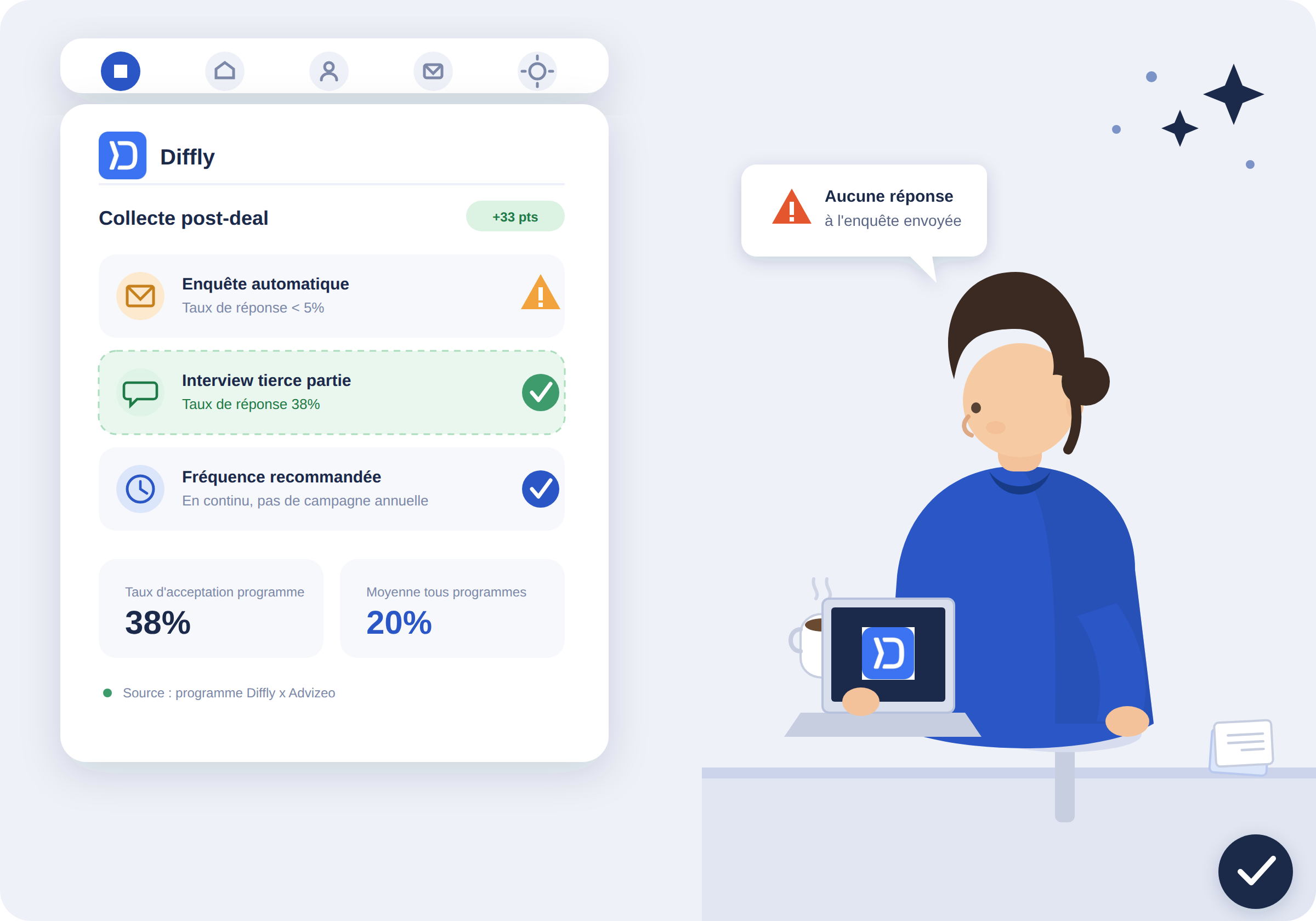
A post-deal survey is an automated message sent to a prospect after an opportunity closes. Its response rate in B2B typically caps below 5%, and the few responses received are too short to be useful. An interview conducted by a neutral third party, on the same pool of prospects, achieves a far higher rate. The difference isn't about the channel used to reach out — it's about the format and who's asking.
Why does a lost prospect ignore your survey?
They have no reason to answer one more message, and four concrete reasons to ignore it.
They owe you nothing. The commercial relationship is over, they expect nothing from you, and no one has explained what their answer would actually produce. The message lands in an inbox already full of requests, with nothing to set it apart from the rest.
They don't want to justify themselves. Filling out a form sent by the vendor they turned down feels like an exercise in justification, not a conversation.
They don't have the vocabulary for your checkboxes. You offer price, features, timing, other. Their real reason doesn't fit any of these boxes, so they tick the closest one or close the tab. That's how price becomes, by default, the most frequent loss reason logged in a CRM — without it always being the real one.
Your survey only surfaces what you already suspect. The questions were written from your internal assumptions. A closed-ended question doesn't uncover anything new — it confirms what you expected to find.
What response rate does an interview by a neutral third party get?
On the program run by Diffly with Advizeo, 38% of the buyers contacted agreed to an interview, compared with the 4 to 5% typically obtained by an automated survey sent to the same population.
Across all programs run by Diffly, the average acceptance rate reaches 20%. The gap between the two formats therefore remains massive, even outside the most favorable case.
Why does a prospect agree to talk to a third party?
Three mechanisms explain this gap in response rates.
1. They have nothing to negotiate
No sales follow-up to worry about, no discount to extract, no relationship to manage for a future contact. The conversation carries no stakes, which completely changes how the prospect perceives the request.
2. They have nothing to justify
In front of the salesperson, they defend their decision. In front of a third party, they simply explain it. These aren't the same words, nor the same level of detail.
3. They're asked for their opinion, not a score
A prospect who spent several weeks on an RFP has a well-formed opinion that no one ever asks for. A well-conducted interview creates space for that story, where a standard message only asks for a number.
Xavier Gounon (Advizeo) summed it up at the Diffly Keynote 2026, explaining that having a neutral interviewer present made it possible to get far more concrete information than a standard questionnaire.
What does an interview add beyond a survey?
Three differences in kind, beyond the simple volume of responses.
A survey gives you a category. An interview gives you a full timeline, and the tipping point of the decision is always found somewhere in that timeline — never in a ticked box.
A survey gives you the official reason. An interview gives you the real reason, often stated toward the end of the conversation, once trust has built between the two people talking.
A survey gives you a score out of five. An interview gives you the prospect's exact words — verbatims that later get used to rewrite your pages and your sales arguments.
How should you structure a post-deal interview?
Five rules produce usable verbatims instead of a polite conversation with no substance.
1. Start with the story, not the reason
The right opening stays simple: "Walk me through how the decision was made, from the first conversation to the final choice." This question opens the conversation instead of closing it.
2. Never open with "why did you choose someone else"
This question shuts down the conversation before it starts, because it demands an immediate justification.
3. Ask what reassured them about the competitor they chose
Rather than asking what was missing on your side, the positive framing produces answers that are far more precise and far less defensive.
4. Look for the moment of hesitation
"Was there a moment when you hesitated?" identifies the tipping point better than any question asked directly.
5. End with an opening
"What would it take for us to work together in the future?" qualifies the account for future prospecting and sometimes reopens the door to a new meeting.
Which channel should you use to reach a prospect for a meeting?
The channel chosen for the first outreach directly influences the response rate, even before the content of the message matters.
Email alone is almost never enough
A single outreach email gets lost in an already saturated inbox. It remains useful as a first written contact, provided it's short and directly proposes a time slot, but it almost never lands a meeting on its own.
Phone remains the most effective channel for making contact
A phone call, even a brief one, creates a human connection that email can't. The prospect perceives a real person rather than one more automated message, which changes how they see the request.
The follow-up matters more than the initial message
A lead who doesn't respond to the first outreach isn't a lost lead. A well-spaced follow-up, on a different channel than the first contact, often gets the response the initial message didn't get on its own. Two to three follow-ups, spread over several weeks, remain reasonable before treating silence as final.
Silence isn't always a refusal
A prospect who doesn't respond within the week hasn't necessarily said no. They may simply not have seen the message, or set it aside without dealing with it. Asking differently, on a different channel, is often more effective than pushing the same message again.
Which phrasings bias an interview without you noticing?
Three common traps skew an interview that seemed well prepared.
The question that suggests its own answer. "Was price a factor?" produces a yes in most cases, even when price wasn't decisive in the decision.
The binary question on a nuanced topic. "Were you satisfied with the demo?" forces a choice between yes and no, when the reality perceived by the prospect is a mix of both.
The question that names a specific competitor. It steers the comparison toward an angle the prospect hadn't spontaneously considered, and skews the rest of the conversation.
How much time does this require from the company?
Less time than it appears, once the process is running smoothly. Getting a meeting takes, on average, one first contact and one to two follow-ups — roughly a quarter of an hour of outreach spread over a few days. The interview itself lasts around thirty minutes.
For a company handling several dozen lost deals per month, this time remains marginal compared with what it delivers: verbatims directly usable by sales and prospecting teams, rather than a table of loss reasons that no salesperson ever reads again.
What to remember
Your lost prospects won't answer your survey, and it's not for lack of something to say. Change who's asking and how, and the same population that ignored your message will give you thirty minutes on the phone or on a video call.
FAQ
What is the average response rate for a B2B post-deal survey?
It typically caps below 5%. Of the few responses received, a large share are scores with no comment, making them unusable for understanding an actual purchase decision.
How long does a win-loss interview last?
About 30 minutes. That's enough to reconstruct the timeline of the decision, identify the real buying committee, and pinpoint the tipping point.
How long after closing should you interview a prospect?
A few weeks. Soon enough that the details are still fresh, late enough that the commercial tension has eased and the prospect more readily agrees to the meeting.
Can these interviews be run in-house, without a third party?
It's possible, but the yield drops sharply. The prospect adapts what they say to who's listening. An employee of the vendor that was turned down gets a diplomatic version, and hears it filtered through their own lens on top of that.
Which channel should you use to propose a meeting to a lost prospect?
A short email to make first contact, followed by a phone call if the message goes unanswered. The most relevant channel remains the one the prospect themselves used most often during the commercial relationship.
How many follow-ups should you send before considering a lead lost for the interview?
Two to three follow-ups are usually enough, spaced a few days to a week apart, alternating between email and phone. Beyond that, silence becomes an answer in itself.

Richtext Templates

"Lorem ipsum dolor sit amet, consectetur adipiscing elit. Suspendisse varius enim in eros elementum tristique."
John Doe
Name, Role @Google

Analysing CRM data is a good 1st step but I know I only get 20% of the real story

Constance Morales
Constance Morales, Product Marketing Manager @ Scaleway