Summarize this article with:
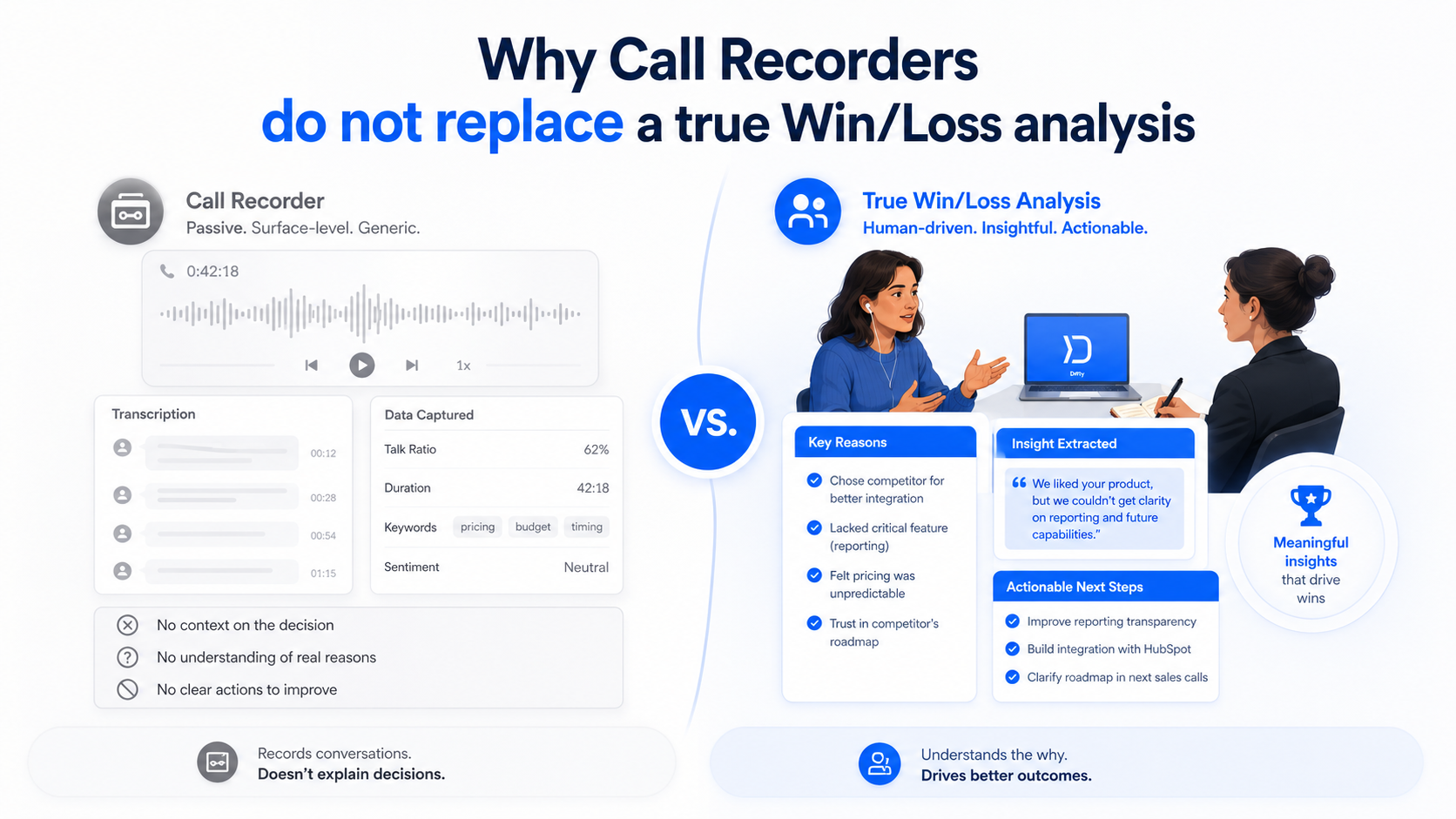
A lost-deal debrief is an interview conducted with a prospect after they have chosen another vendor. Its purpose is to understand a decision, not to obtain a justification. Its value depends almost entirely on the order and the phrasing of the questions, and these five questions are not asked the same way depending on the type of lost deal, or on the stage of the sales cycle at which the prospect withdrew. Most companies open with "why did you choose another vendor," which is the worst possible opening: it invites a short answer and almost always produces the same line, "it came down to budget." According to Clozd (2025 State of Win-Loss Report), 85% of loss reasons recorded in a CRM do not match the real reason the buyer later gives, budget included. According to Gartner (The B2B Buying Journey, 2023), B2B buyers spend only 17% of their total buying time in direct contact with potential vendors: most of the decision therefore plays out beyond your view, and only a debrief can reconstruct it.
The 5 questions at a glance
Question 1 — The story of the decision
Objective: get the real timeline, without accusation.
Standard phrasing: "Walk me through how the decision was made, from the first conversation to the final choice."
Adaptation by deal type: against the status quo, follow up with "what happened after our last proposal".
Question 2 — The buying committee
Objective: identify who actually decided, and when.
Standard phrasing: "Who was involved, and at what point?"
Adaptation by deal type: on an enterprise deal, break it down role by role (technical, finance, leadership); on an SMB deal, look for informal influencers.
Question 3 — What reassured them
Objective: get the competitor's real value proposition.
Standard phrasing: "What reassured you the most about the vendor you chose?"
Adaptation by deal type: against the status quo, rephrase as "what reassured you about the idea of not changing anything".
Question 4 — The moment of hesitation
Objective: locate the exact tipping point.
Standard phrasing: "Was there a moment when you hesitated?"
Adaptation by deal type: on a deal lost early, ask "at what point did you feel this was no longer a priority".
Question 5 — The opening
Objective: qualify the deal and leave the door open.
Standard phrasing: "What would it take for us to work together?"
Adaptation by deal type: against a status quo, ask "what signal would tell you it's time to reopen the conversation".
Question 1: how was the decision made, from the first conversation to the final choice?
This is the opening question, because it asks for a story, not a verdict.
This question is chronological and it accuses no one. What it produces: the real course of events, the steps you never saw, the internal meetings you didn't know existed. It's the simplest question to ask, and the most useful for understanding the prospect's real context. A B2B sales cycle now lasts 6.5 months on average, up from 4.9 months in 2019 according to Ebsta: the longer this timeframe stretches, the more invisible steps accumulate for the salesperson.
It's also within this narrative that the tipping point appears. The prospect never hands it over if asked directly: they let it slip mid-sentence, while talking about something else. This question should be asked literally as worded, with no unnecessary rephrasing.
Let them talk without interrupting. Silence produces more information than follow-up prompts.
Adapting the question by deal type. On a deal lost to an identified competitor, the story naturally follows a comparison between two offers. On a deal lost to the status quo or to no decision at all, the story rarely starts from a comparison: in that case the question needs to be asked differently, with "and what happened after our last proposal," to surface the moment the project slipped rather than was decided. This case is not marginal: according to Forrester Sales Research (2019), 60% of B2B pipeline deals end in no decision rather than in a win for an identified competitor.
Question 2: who was involved, and at what point?
This question reveals the half of the buying committee you didn't know about, and helps you understand who actually made the decision at this account. According to Gartner, a B2B buying committee now has between 8 and 13 stakeholders, up from an average of 5.4 in 2015: the larger this committee grows, the higher the likelihood you're missing part of it.
From the buyer's point of view, you discover contacts absent from your CRM (Salesforce, HubSpot, or any equivalent tool). Security, who raised an objection. Legal, who held things up for three weeks. The CFO, the CIO, the CTO, or the head of product who never attended a demo but who made the call.
This question also reveals the timing of their entry into the sales process. A veto-holding stakeholder who shows up late is a deadly configuration for the salesperson running the deal, and it becomes recognizable once you know it exists for this type of client. This question should be asked literally as worded, regardless of the prospect.
Adapting the question by deal type. On an enterprise deal with a large buying committee, this question is asked almost role by role: "who else was consulted on the technical side, on finance, on leadership." On an SMB deal with a single decision-maker, the question changes in nature: it's less about the committee and more about informal influencers, a colleague consulted outside the official process, an opinion sought outside the company.
Question 3: what reassured you the most about the vendor you chose?
The positive framing produces far more precise answers than the negative framing, and helps uncover the prospect's real perceived value proposition. This question should be asked literally as worded.
A question that asks what was missing from you invites criticism, and the buyer softens it out of politeness. A question that asks what convinced them about the other vendor invites a description, and the prospect gives details about the product and solution chosen.
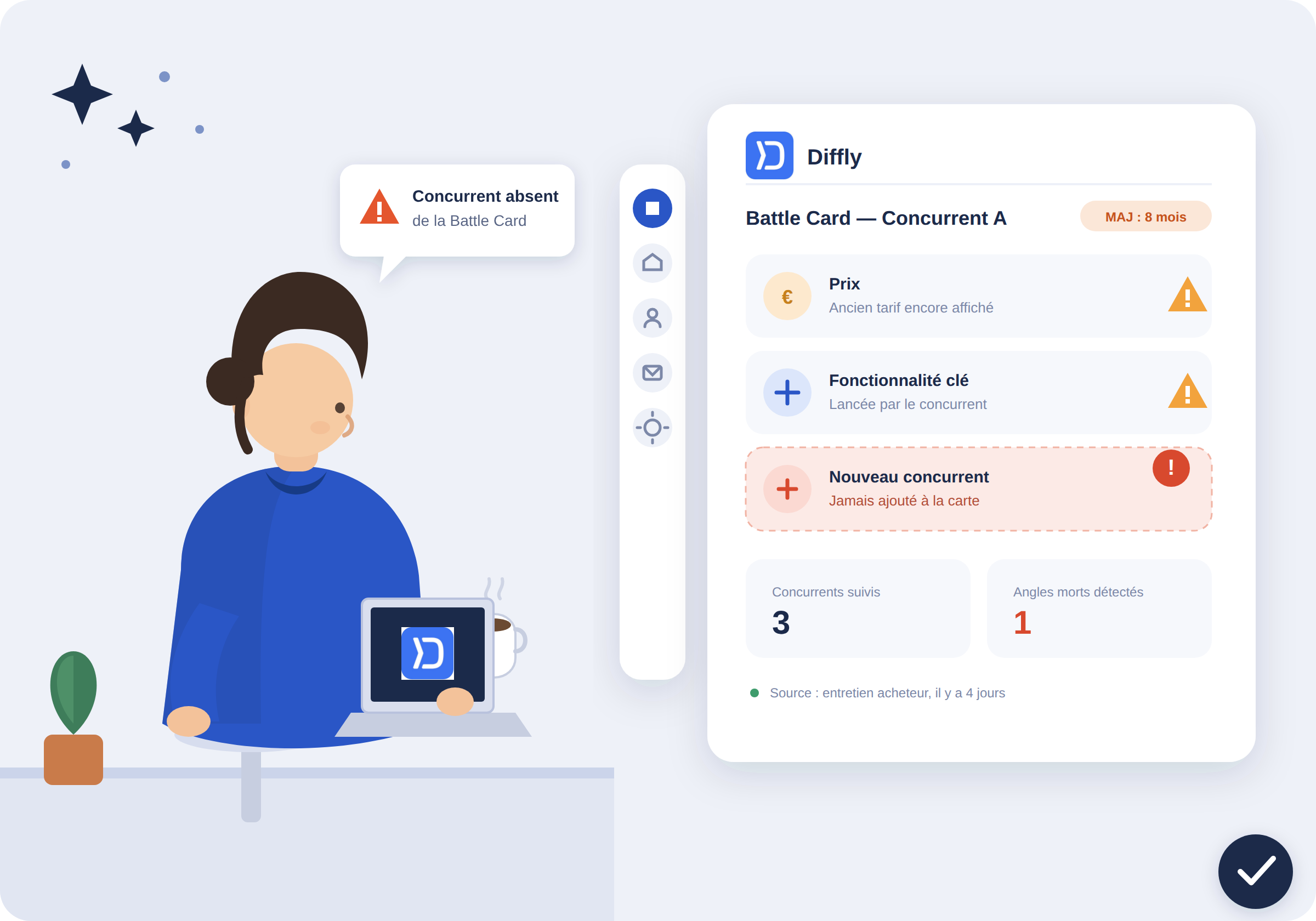
This gives you your competitor's real value proposition, phrased by a buyer rather than by the other vendor's marketing department. It's the best material there is for updating a battle card, adjusting your product messaging, or revisiting an entire team's sales strategy.
Adapting the question by deal type. If the buyer didn't choose a competitor but the status quo or an in-house build, the question is rephrased: "what reassured you about the idea of not changing anything for now" or "what tipped you toward a solution built in-house." The mechanism stays the same: look for what convinced them, not what was missing.
Question 4: was there a moment when you hesitated?
This question identifies the tipping point, the one spot where the deal could have gone differently, and helps you understand how the prospect ultimately decided.
In almost every lost deal, there is a precise moment of tipping. An unresolved doubt, a response that came too slowly, a product argument that was missing exactly when the champion needed it in front of their committee.
The buyer answers readily, because the question honors their thinking instead of challenging their decision. This question should be asked literally as worded, with no variant needed.
What you get from it is concrete sales coaching: not a general lesson, but a specific moment to play differently next time in a similar situation.
Adapting the question by deal type. On a deal lost early in the cycle, before a demo or a priced proposal, the hesitation is often about initial trust rather than a product criterion: in that case the question needs to be asked differently, with "at what point did you feel this was no longer a priority," to capture fading attention rather than a comparison.
Question 5: what would it take for us to work together?
This final question qualifies the deal and reopens it at the same time, without forcing the prospect to commit to anything. Understanding where the deal really stands matters more than getting a promise.
What the buyer says right away reveals whether the deal is closed or on pause. "Honestly, nothing in the short term" and "come back once you have this product integration" do not describe the same situation.
Across programs run by Diffly, 22% of lost deals reactivate within twelve months. Budget deferred rather than declined, the competitor's rollout running into trouble, a sponsor changing roles, a market shifting. This question leaves the door open without pushing, and gives the sales team a real opportunity to track rather than a file closed for good. This question should be asked literally as worded.
Adapting the question by deal type. Facing another vendor recently put in place, the question naturally extends into "what would make you reconsider a solution like ours in this context." Facing a status quo, it extends instead into "what signal would tell you it's time to reopen the conversation," to identify the right moment for a future follow-up rather than forcing an immediate return.
What mistakes should you avoid in a lost-deal debrief?
Three mistakes cancel out the value of the interview, regardless of the type of deal.
- Asking for a rating out of ten. That rating says nothing, compares to nothing, and turns a conversation into a form.
- Asking questions that contain their own answer. "Did price play a role" produces a yes even when it wasn't decisive.
- Handing the interview to the salesperson or the sales manager who owned the deal. Either one will get a diplomatic version and will hear it through their own filter, no matter how carefully the questions are phrased.
How should you ask these five questions out loud?
Asking the buyer these questions out loud calls for a calm, almost neutral tone, with no mechanical reading from a list. It's better to ask a question and let the silence do its work than to rattle off questions back-to-back without a breath between them. A simple good practice is to ask the question, note what's said without rephrasing it, then ask the next one only once the prospect has finished their thought.
What should you do with what was said once the interview is over?
A good debrief doesn't stop at the interview. The goal remains to understand a decision in order to act on it, not simply to document it.
Identify what concerns the product, and what concerns the sales process
Some elements point to a product or solution problem: a missing feature, an implementation timeline seen as too long, a price perceived as high relative to the value offered. Other elements point to the sales process itself: a salesperson too slow to respond, a lack of follow-up between meetings, a proposal sent without the right elements.
Separating these two categories is the first thing to do to properly understand the deal. A poorly identified result ends up recommending a product change where the real issue was a lack of rigor in customer follow-up, or the reverse.
Turn what was said into sales action
The point of a debrief isn't to build an archive, but to give concrete input to the sales team, the product manager, and, in an actively competitive market, the market analyst tracking competitor moves. A hesitation identified across several similar deals becomes, for the salesperson, an argument to prepare in advance. A loss reason that recurs across several deals becomes, for the product manager, a priority issue rather than an isolated anecdote.
Every week or every month depending on the volume of lost deals, collecting these elements and sharing them with the relevant salesperson remains the best way to turn a one-off conversation into a lasting improvement in win rate for the target market.
Keep a usable record, not just a checked box
A well-run debrief captures the buyer's voice through precise verbatims, a clear timeline, and a real reason. These three elements are enough for a salesperson to work differently on their next similar deal, without needing to re-read the entire interview every time.
Key takeaways
The information exists, and your lost buyers are largely willing to talk about it. What unlocks it is the order of the questions, how they're adapted to the type of deal, and who asks them. Start with the story, end with the opening, and hand the interview to someone who has nothing to defend.
FAQ
What is the first question to ask in a lost-deal debrief?
"Walk me through how the decision was made, from the first conversation to the final choice." This question is chronological, it accuses no one, and it surfaces the steps that were invisible from the outside.
Why not ask directly why you lost?
Because the question puts the prospect in a position of having to justify themselves. The prospect then gives the shortest, least engaging answer possible, usually budget, which closes the conversation without teaching you anything.
Do the same questions work for a deal lost to a competing vendor and a deal lost to the status quo?
The substance of the five questions stays the same, but their phrasing changes. Facing a choice between two offers, the questions naturally focus on a comparison. Facing a status quo or no decision, they need to be rephrased to surface a drift rather than a decision.
How many questions should you plan for, and how should you ask them?
Five open-ended questions are enough for a thirty-minute interview, asked one at a time without rushing. Beyond that, the interview turns into a questionnaire and the prospect shortens what they say.
Should you record the interview?
Yes, with the buyer's consent. Raw verbatims are worth far more than summaries, because a salesperson remembers a prospect's exact words and forgets a paraphrase.

Richtext Templates

"Lorem ipsum dolor sit amet, consectetur adipiscing elit. Suspendisse varius enim in eros elementum tristique."
John Doe
Name, Role @Google

Analysing CRM data is a good 1st step but I know I only get 20% of the real story

Constance Morales
Constance Morales, Product Marketing Manager @ Scaleway